Geant4 11.4.0
Toolkit for the simulation of the passage of particles through matter
Loading...
Searching...
No Matches
G4TheoFSGenerator Class Reference

#include <G4TheoFSGenerator.hh>

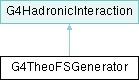
Inheritance diagram for G4TheoFSGenerator:

Public Member Functions

 G4TheoFSGenerator (const G4String &name="TheoFSGenerator")
 ~G4TheoFSGenerator () override
 G4TheoFSGenerator (const G4TheoFSGenerator &right)=delete
const G4TheoFSGeneratoroperator= (const G4TheoFSGenerator &right)=delete
G4bool operator== (const G4TheoFSGenerator &right) const =delete
G4bool operator!= (const G4TheoFSGenerator &right) const =delete
G4HadFinalStateApplyYourself (const G4HadProjectile &thePrimary, G4Nucleus &theNucleus) override
void SetTransport (G4VIntraNuclearTransportModel *const value)
void SetHighEnergyGenerator (G4VHighEnergyGenerator *const value)
void SetQuasiElasticChannel (G4QuasiElasticChannel *const value)
const G4VIntraNuclearTransportModelGetTransport () const
const G4VHighEnergyGeneratorGetHighEnergyGenerator () const
const G4QuasiElasticChannelGetQuasiElasticChannel () const
std::pair< G4double, G4doubleGetEnergyMomentumCheckLevels () const override
void ModelDescription (std::ostream &outFile) const override
Public Member Functions inherited from G4HadronicInteraction
 G4HadronicInteraction (const G4String &modelName="HadronicModel")
virtual ~G4HadronicInteraction ()
virtual G4double SampleInvariantT (const G4ParticleDefinition *p, G4double plab, G4int Z, G4int A)
virtual G4bool IsApplicable (const G4HadProjectile &aTrack, G4Nucleus &targetNucleus)
G4double GetMinEnergy () const
G4double GetMinEnergy (const G4Material *aMaterial, const G4Element *anElement) const
void SetMinEnergy (G4double anEnergy)
void SetMinEnergy (G4double anEnergy, const G4Element *anElement)
void SetMinEnergy (G4double anEnergy, const G4Material *aMaterial)
G4double GetMaxEnergy () const
G4double GetMaxEnergy (const G4Material *aMaterial, const G4Element *anElement) const
void SetMaxEnergy (const G4double anEnergy)
void SetMaxEnergy (G4double anEnergy, const G4Element *anElement)
void SetMaxEnergy (G4double anEnergy, const G4Material *aMaterial)
G4int GetVerboseLevel () const
void SetVerboseLevel (G4int value)
const G4StringGetModelName () const
void DeActivateFor (const G4Material *aMaterial)
void ActivateFor (const G4Material *aMaterial)
void DeActivateFor (const G4Element *anElement)
void ActivateFor (const G4Element *anElement)
G4bool IsBlocked (const G4Material *aMaterial) const
G4bool IsBlocked (const G4Element *anElement) const
void SetRecoilEnergyThreshold (G4double val)
G4double GetRecoilEnergyThreshold () const
virtual const std::pair< G4double, G4doubleGetFatalEnergyCheckLevels () const
void SetEnergyMomentumCheckLevels (G4double relativeLevel, G4double absoluteLevel)
virtual void BuildPhysicsTable (const G4ParticleDefinition &)
virtual void InitialiseModel ()
 G4HadronicInteraction (const G4HadronicInteraction &right)=delete
const G4HadronicInteractionoperator= (const G4HadronicInteraction &right)=delete
G4bool operator== (const G4HadronicInteraction &right) const =delete
G4bool operator!= (const G4HadronicInteraction &right) const =delete

Additional Inherited Members

Protected Member Functions inherited from G4HadronicInteraction
void SetModelName (const G4String &nam)
G4bool IsBlocked () const
void Block ()
Protected Attributes inherited from G4HadronicInteraction
G4HadFinalState theParticleChange
G4int verboseLevel
G4double theMinEnergy
G4double theMaxEnergy
G4bool isBlocked

Detailed Description

Definition at line 52 of file G4TheoFSGenerator.hh.

Constructor & Destructor Documentation

◆ G4TheoFSGenerator() [1/2]

G4TheoFSGenerator::G4TheoFSGenerator ( const G4String & name = "TheoFSGenerator")
explicit

Definition at line 43 of file G4TheoFSGenerator.cc.

44 : G4HadronicInteraction( name )
45 , theTransport( nullptr ), theHighEnergyGenerator( nullptr )
46 , theQuasielastic( nullptr ), theCosmicCoalescence( nullptr )
47 , theStringModelID( -1 ), theFTFQuasiElasticID( -1 ), theFTFDiffractiveID( -1 )
48{
49 theParticleChange = new G4HadFinalState;
50 theStringModelID = G4PhysicsModelCatalog::GetModelID( "model_" + name );
51 theFTFQuasiElasticID = G4PhysicsModelCatalog::GetModelID( "model_QuasiElastic_FTF" );
52 theFTFDiffractiveID = G4PhysicsModelCatalog::GetModelID( "model_Diffractive_FTF" );
53}
G4HadronicInteraction(const G4String &modelName="HadronicModel")
static G4int GetModelID(const G4int modelIndex)

Referenced by G4TheoFSGenerator(), operator!=(), operator=(), and operator==().

◆ ~G4TheoFSGenerator()

G4TheoFSGenerator::~G4TheoFSGenerator ( )
override

Definition at line 56 of file G4TheoFSGenerator.cc.

57{
58 delete theParticleChange;
59}

◆ G4TheoFSGenerator() [2/2]

G4TheoFSGenerator::G4TheoFSGenerator ( const G4TheoFSGenerator & right)
delete

Member Function Documentation

◆ ApplyYourself()

G4HadFinalState * G4TheoFSGenerator::ApplyYourself ( const G4HadProjectile & thePrimary,
G4Nucleus & theNucleus )
overridevirtual

Reimplemented from G4HadronicInteraction.

Definition at line 77 of file G4TheoFSGenerator.cc.

78{
79 // init particle change
80 theParticleChange->Clear();
81 theParticleChange->SetStatusChange( stopAndKill );
82 G4double timePrimary = thePrimary.GetGlobalTime();
83
84 // Temporarily dummy treatment of heavy (charm and bottom) hadron projectiles at low energies.
85 // Cascade models are currently not applicable for heavy hadrons and string models cannot
86 // handle them properly at low energies - let's say safely below ~100 MeV.
87 // In these cases, we return as final state the initial state unchanged.
88 // For most applications, this is a safe simplification, giving that the nearly all
89 // slowly moving charm and bottom hadrons decay before any hadronic interaction can occur.
90 // Note that we prefer not to use G4HadronicParameters::GetMinEnergyTransitionFTF_Cascade()
91 // (typically ~3 GeV) because FTFP works reasonably well below such a value.
92 const G4double energyThresholdForCharmAndBottomHadrons = 100.0*CLHEP::MeV;
93 if ( thePrimary.GetKineticEnergy() < energyThresholdForCharmAndBottomHadrons &&
94 ( thePrimary.GetDefinition()->GetQuarkContent( 4 ) != 0 || // Has charm constituent quark
95 thePrimary.GetDefinition()->GetAntiQuarkContent( 4 ) != 0 || // Has anti-charm constituent anti-quark
96 thePrimary.GetDefinition()->GetQuarkContent( 5 ) != 0 || // Has bottom constituent quark
97 thePrimary.GetDefinition()->GetAntiQuarkContent( 5 ) != 0 ) ) { // Has anti-bottom constituent anti-quark
98 theParticleChange->SetStatusChange( isAlive );
99 theParticleChange->SetEnergyChange( thePrimary.GetKineticEnergy() );
100 theParticleChange->SetMomentumChange( thePrimary.Get4Momentum().vect().unit() );
101 return theParticleChange;
102 }
103
104 // Temporarily dummy treatment of light hypernuclei projectiles at low energies.
105 // Bertini and Binary intra-nuclear cascade models are currently not applicable
106 // for hypernuclei and string models cannot handle them properly at low energies -
107 // let's say safely below ~100 MeV.
108 // In these cases, we return as final state the initial state unchanged.
109 // For most applications, this is a safe simplification, giving that the nearly all
110 // slowly moving hypernuclei decay before any hadronic interaction can occur.
111 // Note that we prefer not to use G4HadronicParameters::GetMinEnergyTransitionFTF_Cascade()
112 // (typically ~3 GeV) because FTFP works reasonably well below such a value.
113 // Note that for anti-hypernuclei, FTF model works fine down to zero kinetic energy,
114 // so there is no need of any extra, dummy treatment.
115 const G4double energyThresholdForHyperNuclei = 100.0*CLHEP::MeV;
116 if ( thePrimary.GetKineticEnergy() < energyThresholdForHyperNuclei &&
117 thePrimary.GetDefinition()->IsHypernucleus() ) {
118 theParticleChange->SetStatusChange( isAlive );
119 theParticleChange->SetEnergyChange( thePrimary.GetKineticEnergy() );
120 theParticleChange->SetMomentumChange( thePrimary.Get4Momentum().vect().unit() );
121 return theParticleChange;
122 }
123
124 // check if models have been registered, and use default, in case this is not true @@
125
126 const G4DynamicParticle aPart( thePrimary.GetDefinition(), thePrimary.Get4Momentum().vect() );
127
128 if ( theQuasielastic )
129 {
130 if ( theQuasielastic->GetFraction( theNucleus, aPart ) > G4UniformRand() )
131 {
132 //G4cout<<"___G4TheoFSGenerator: before Scatter (1) QE=" << theQuasielastic<<G4endl;
133 G4KineticTrackVector* result= theQuasielastic->Scatter( theNucleus, aPart );
134 //G4cout << "^^G4TheoFSGenerator: after Scatter (1) " << G4endl;
135 if ( result )
136 {
137 for ( auto & ptr : *result )
138 {
139 G4DynamicParticle* aNew = new G4DynamicParticle( ptr->GetDefinition(),
140 ptr->Get4Momentum().e(),
141 ptr->Get4Momentum().vect() );
142 theParticleChange->AddSecondary( aNew, ptr->GetCreatorModelID() );
143 delete ptr;
144 }
145 delete result;
146 }
147 else
148 {
149 theParticleChange->SetStatusChange( isAlive );
150 theParticleChange->SetEnergyChange( thePrimary.GetKineticEnergy() );
151 theParticleChange->SetMomentumChange( thePrimary.Get4Momentum().vect().unit() );
152 }
153 return theParticleChange;
154 }
155 }
156
157 // get result from high energy model
158 G4KineticTrackVector* theInitialResult = theHighEnergyGenerator->Scatter( theNucleus, aPart );
159
160 // Assign the creator model ID.
161 // Only for the FTF string model, an inelastic interaction can be classified as quasi-elastic
162 // or diffractive. For the QGS model, the two boolean methods below return always "false".
163 G4int theModelID = theStringModelID;
164 if ( theHighEnergyGenerator->IsQuasiElasticInteraction() ) {
165 theModelID = theFTFQuasiElasticID;
166 } else if ( theHighEnergyGenerator->IsDiffractiveInteraction() ) {
167 theModelID = theFTFDiffractiveID;
168 }
169 for ( auto & ptr : *theInitialResult ) {
170 ptr->SetCreatorModelID( theModelID );
171 }
172
173 //#define DEBUG_initial_result
174 #ifdef DEBUG_initial_result
175 G4double E_out( 0 );
176 G4IonTable* ionTable = G4ParticleTable::GetParticleTable()->GetIonTable();
177 for ( auto & ptr : *theInitialResult )
178 {
179 //G4cout << "TheoFS secondary, mom " << ptr->GetDefinition()->GetParticleName()
180 // << " " << ptr->Get4Momentum() << G4endl;
181 E_out += ptr->Get4Momentum().e();
182 }
183 G4double init_mass = ionTable->GetIonMass( theNucleus.GetZ_asInt(), theNucleus.GetA_asInt() );
184 G4double init_E = aPart.Get4Momentum().e();
185 // residual nucleus
186
187 const std::vector< G4Nucleon >& thy = theHighEnergyGenerator->GetWoundedNucleus()->GetNucleons();
188
189 G4int resZ( 0 ), resA( 0 );
190 G4double delta_m( 0.0 );
191 for ( auto & nuc : thy )
192 {
193 if ( nuc.AreYouHit() ) {
194 ++resA;
195 if ( nuc.GetDefinition() == G4Proton::Proton() ) {
196 ++resZ;
197 delta_m += CLHEP::proton_mass_c2;
198 } else {
199 delta_m += CLHEP::neutron_mass_c2;
200 }
201 }
202 }
203
204 G4double final_mass( 0.0 );
205 if ( theNucleus.GetA_asInt() ) {
206 final_mass = ionTable->GetIonMass( theNucleus.GetZ_asInt() - resZ,theNucleus.GetA_asInt() - resA );
207 }
208 G4double E_excit = init_mass + init_E - final_mass - E_out;
209 G4cout << " Corrected delta mass " << init_mass - final_mass - delta_m << G4endl;
210 G4cout << "initial E, mass = " << init_E << ", " << init_mass << G4endl;
211 G4cout << " final E, mass = " << E_out <<", " << final_mass << " excitation_E " << E_excit << G4endl;
212 #endif
213
214 G4ReactionProductVector* theTransportResult = nullptr;
215
216 G4V3DNucleus* theProjectileNucleus = theHighEnergyGenerator->GetProjectileNucleus();
217 if ( theProjectileNucleus == nullptr )
218 {
219 G4int hitCount = 0;
220 const std::vector< G4Nucleon >& they = theHighEnergyGenerator->GetWoundedNucleus()->GetNucleons();
221 for ( auto & nuc : they )
222 {
223 if ( nuc.AreYouHit() ) ++hitCount;
224 }
225 if ( hitCount != theHighEnergyGenerator->GetWoundedNucleus()->GetMassNumber() )
226 {
227 theTransport->SetPrimaryProjectile( thePrimary );
228 theTransportResult = theTransport->Propagate( theInitialResult,
229 theHighEnergyGenerator->GetWoundedNucleus() );
230 if ( theTransportResult == nullptr ) {
231 G4cout << "G4TheoFSGenerator: null ptr from transport propagate " << G4endl;
232 throw G4HadronicException( __FILE__, __LINE__, "Null ptr from transport propagate" );
233 }
234 }
235 else
236 {
237 theTransportResult = theDecay.Propagate( theInitialResult,
238 theHighEnergyGenerator->GetWoundedNucleus() );
239 if ( theTransportResult == nullptr ) {
240 G4cout << "G4TheoFSGenerator: null ptr from decay propagate " << G4endl;
241 throw G4HadronicException( __FILE__, __LINE__, "Null ptr from decay propagate" );
242 }
243 }
244 }
245 else
246 {
247 theTransport->SetPrimaryProjectile( thePrimary );
248 theTransportResult = theTransport->PropagateNuclNucl( theInitialResult,
249 theHighEnergyGenerator->GetWoundedNucleus(),
250 theProjectileNucleus );
251 if ( theTransportResult == nullptr ) {
252 G4cout << "G4TheoFSGenerator: null ptr from transport propagate " << G4endl;
253 throw G4HadronicException( __FILE__, __LINE__, "Null ptr from transport propagate" );
254 }
255 }
256
257 // If enabled, apply the Cosmic Rays (CR) coalescence to the list of secondaries produced so far.
258 // This algorithm can form deuterons and antideuterons by coalescence of, respectively,
259 // proton-neutron and antiproton-antineutron pairs close in momentum space.
260 // This can be useful in particular for Cosmic Ray applications.
261 if ( G4HadronicParameters::Instance()->EnableCRCoalescence() ) {
262 if ( theCosmicCoalescence == nullptr ) {
263 theCosmicCoalescence = (G4CRCoalescence*)
265 if ( theCosmicCoalescence == nullptr ) {
266 theCosmicCoalescence = new G4CRCoalescence;
267 }
268 }
269 theCosmicCoalescence->SetP0Coalescence( thePrimary, theHighEnergyGenerator->GetModelName() );
270 theCosmicCoalescence->GenerateDeuterons( theTransportResult );
271 }
272
273 // Fill particle change
274 for ( auto & ptr : *theTransportResult )
275 {
276 G4DynamicParticle* aNewDP = new G4DynamicParticle( ptr->GetDefinition(),
277 ptr->GetTotalEnergy(),
278 ptr->GetMomentum() );
279 G4HadSecondary aNew = G4HadSecondary( aNewDP );
280 G4double time = std::max( ptr->GetFormationTime(), 0.0 );
281 aNew.SetTime( timePrimary + time );
282 aNew.SetCreatorModelID( ptr->GetCreatorModelID() );
283 aNew.SetParentResonanceDef( ptr->GetParentResonanceDef() );
284 aNew.SetParentResonanceID( ptr->GetParentResonanceID() );
285 theParticleChange->AddSecondary( aNew );
286 delete ptr;
287 }
288
289 // some garbage collection
290 delete theTransportResult;
291
292 // Done
293 return theParticleChange;
294}
@ isAlive
@ stopAndKill
std::vector< G4ReactionProduct * > G4ReactionProductVector
double G4double
Definition G4Types.hh:83
int G4int
Definition G4Types.hh:85
#define G4endl
Definition G4ios.hh:67
G4GLOB_DLL std::ostream G4cout
#define G4UniformRand()
Definition Randomize.hh:52
Hep3Vector unit() const
Hep3Vector vect() const
const G4ParticleDefinition * GetDefinition() const
G4double GetKineticEnergy() const
const G4LorentzVector & Get4Momentum() const
G4double GetGlobalTime() const
void SetParentResonanceDef(const G4ParticleDefinition *parentDef)
void SetTime(G4double aT)
void SetCreatorModelID(G4int id)
void SetParentResonanceID(const G4int parentID)
G4HadronicInteraction * FindModel(const G4String &name)
static G4HadronicInteractionRegistry * Instance()
static G4HadronicParameters * Instance()
G4double GetIonMass(G4int Z, G4int A, G4int nL=0, G4int lvl=0) const
G4int GetA_asInt() const
Definition G4Nucleus.hh:78
G4int GetZ_asInt() const
Definition G4Nucleus.hh:84
G4int GetQuarkContent(G4int flavor) const
G4bool IsHypernucleus() const
G4int GetAntiQuarkContent(G4int flavor) const
G4IonTable * GetIonTable() const
static G4ParticleTable * GetParticleTable()
static G4Proton * Proton()
Definition G4Proton.cc:90

◆ GetEnergyMomentumCheckLevels()

std::pair< G4double, G4double > G4TheoFSGenerator::GetEnergyMomentumCheckLevels ( ) const
overridevirtual

Reimplemented from G4HadronicInteraction.

Definition at line 297 of file G4TheoFSGenerator.cc.

298{
299 if ( theHighEnergyGenerator ) {
300 return theHighEnergyGenerator->GetEnergyMomentumCheckLevels();
301 } else {
302 return std::pair<G4double, G4double>( DBL_MAX, DBL_MAX );
303 }
304}
#define DBL_MAX
Definition templates.hh:62

◆ GetHighEnergyGenerator()

const G4VHighEnergyGenerator * G4TheoFSGenerator::GetHighEnergyGenerator ( ) const
inline

Definition at line 108 of file G4TheoFSGenerator.hh.

109{
110 return theHighEnergyGenerator;
111}

◆ GetQuasiElasticChannel()

const G4QuasiElasticChannel * G4TheoFSGenerator::GetQuasiElasticChannel ( ) const
inline

Definition at line 113 of file G4TheoFSGenerator.hh.

114{
115 return theQuasielastic;
116}

◆ GetTransport()

const G4VIntraNuclearTransportModel * G4TheoFSGenerator::GetTransport ( ) const
inline

Definition at line 103 of file G4TheoFSGenerator.hh.

104{
105 return theTransport;
106}

◆ ModelDescription()

void G4TheoFSGenerator::ModelDescription ( std::ostream & outFile) const
overridevirtual

Reimplemented from G4HadronicInteraction.

Definition at line 62 of file G4TheoFSGenerator.cc.

63{
64 outFile << GetModelName() <<" consists of a " << theHighEnergyGenerator->GetModelName()
65 << " string model and a stage to de-excite the excited nuclear fragment.\n<p>"
66 << "The string model simulates the interaction of\n"
67 << "an incident hadron with a nucleus, forming \n"
68 << "excited strings, decays these strings into hadrons,\n"
69 << "and leaves an excited nucleus. \n"
70 << "<p>The string model:\n";
71 theHighEnergyGenerator->ModelDescription( outFile );
72 outFile << "\n<p>";
73 theTransport->PropagateModelDescription( outFile );
74}
const G4String & GetModelName() const

◆ operator!=()

G4bool G4TheoFSGenerator::operator!= ( const G4TheoFSGenerator & right) const
delete

◆ operator=()

const G4TheoFSGenerator & G4TheoFSGenerator::operator= ( const G4TheoFSGenerator & right)
delete

◆ operator==()

G4bool G4TheoFSGenerator::operator== ( const G4TheoFSGenerator & right) const
delete

◆ SetHighEnergyGenerator()

◆ SetQuasiElasticChannel()

void G4TheoFSGenerator::SetQuasiElasticChannel ( G4QuasiElasticChannel *const value)
inline

Definition at line 98 of file G4TheoFSGenerator.hh.

99{
100 theQuasielastic = value;
101}

Referenced by G4QGSBuilder::BuildModel().

◆ SetTransport()


The documentation for this class was generated from the following files: