Geant4 11.4.0
Toolkit for the simulation of the passage of particles through matter
Loading...
Searching...
No Matches
G4INCLXXInterface Class Reference

INCL++ intra-nuclear cascade. More...

#include <G4INCLXXInterface.hh>

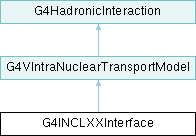
Inheritance diagram for G4INCLXXInterface:

Public Member Functions

 G4INCLXXInterface (G4VPreCompoundModel *const aPreCompound=0)
 ~G4INCLXXInterface ()
G4bool operator== (G4INCLXXInterface &right)
G4bool operator!= (G4INCLXXInterface &right)
G4ReactionProductVectorPropagate (G4KineticTrackVector *theSecondaries, G4V3DNucleus *theNucleus)
G4HadFinalStateApplyYourself (const G4HadProjectile &aTrack, G4Nucleus &theNucleus)
void DeleteModel ()
virtual void ModelDescription (std::ostream &outFile) const
G4String const & GetDeExcitationModelName () const
void SetDeExcitation (G4VPreCompoundModel *ptr)
Public Member Functions inherited from G4VIntraNuclearTransportModel
 G4VIntraNuclearTransportModel (const G4String &mName="CascadeModel", G4VPreCompoundModel *ptr=nullptr)
virtual ~G4VIntraNuclearTransportModel ()
virtual G4ReactionProductVectorPropagateNuclNucl (G4KineticTrackVector *theSecondaries, G4V3DNucleus *theNucleus, G4V3DNucleus *theProjectileNucleus)
void SetDeExcitation (G4VPreCompoundModel *ptr)
void Set3DNucleus (G4V3DNucleus *const value)
void SetPrimaryProjectile (const G4HadProjectile &aPrimary)
const G4StringGetModelName () const
virtual void PropagateModelDescription (std::ostream &outFile) const
 G4VIntraNuclearTransportModel (const G4VIntraNuclearTransportModel &right)=delete
const G4VIntraNuclearTransportModeloperator= (const G4VIntraNuclearTransportModel &right)=delete
G4bool operator== (const G4VIntraNuclearTransportModel &right) const =delete
G4bool operator!= (const G4VIntraNuclearTransportModel &right) const =delete
Public Member Functions inherited from G4HadronicInteraction
 G4HadronicInteraction (const G4String &modelName="HadronicModel")
virtual ~G4HadronicInteraction ()
virtual G4double SampleInvariantT (const G4ParticleDefinition *p, G4double plab, G4int Z, G4int A)
virtual G4bool IsApplicable (const G4HadProjectile &aTrack, G4Nucleus &targetNucleus)
G4double GetMinEnergy () const
G4double GetMinEnergy (const G4Material *aMaterial, const G4Element *anElement) const
void SetMinEnergy (G4double anEnergy)
void SetMinEnergy (G4double anEnergy, const G4Element *anElement)
void SetMinEnergy (G4double anEnergy, const G4Material *aMaterial)
G4double GetMaxEnergy () const
G4double GetMaxEnergy (const G4Material *aMaterial, const G4Element *anElement) const
void SetMaxEnergy (const G4double anEnergy)
void SetMaxEnergy (G4double anEnergy, const G4Element *anElement)
void SetMaxEnergy (G4double anEnergy, const G4Material *aMaterial)
G4int GetVerboseLevel () const
void SetVerboseLevel (G4int value)
const G4StringGetModelName () const
void DeActivateFor (const G4Material *aMaterial)
void ActivateFor (const G4Material *aMaterial)
void DeActivateFor (const G4Element *anElement)
void ActivateFor (const G4Element *anElement)
G4bool IsBlocked (const G4Material *aMaterial) const
G4bool IsBlocked (const G4Element *anElement) const
void SetRecoilEnergyThreshold (G4double val)
G4double GetRecoilEnergyThreshold () const
virtual const std::pair< G4double, G4doubleGetFatalEnergyCheckLevels () const
virtual std::pair< G4double, G4doubleGetEnergyMomentumCheckLevels () const
void SetEnergyMomentumCheckLevels (G4double relativeLevel, G4double absoluteLevel)
virtual void BuildPhysicsTable (const G4ParticleDefinition &)
virtual void InitialiseModel ()
 G4HadronicInteraction (const G4HadronicInteraction &right)=delete
const G4HadronicInteractionoperator= (const G4HadronicInteraction &right)=delete
G4bool operator== (const G4HadronicInteraction &right) const =delete
G4bool operator!= (const G4HadronicInteraction &right) const =delete

Additional Inherited Members

Protected Member Functions inherited from G4VIntraNuclearTransportModel
G4V3DNucleusGet3DNucleus () const
G4VPreCompoundModelGetDeExcitation () const
const G4HadProjectileGetPrimaryProjectile () const
Protected Member Functions inherited from G4HadronicInteraction
void SetModelName (const G4String &nam)
G4bool IsBlocked () const
void Block ()
Protected Attributes inherited from G4VIntraNuclearTransportModel
G4String theTransportModelName
G4V3DNucleusthe3DNucleus
G4VPreCompoundModeltheDeExcitation
const G4HadProjectilethePrimaryProjectile
Protected Attributes inherited from G4HadronicInteraction
G4HadFinalState theParticleChange
G4int verboseLevel
G4double theMinEnergy
G4double theMaxEnergy
G4bool isBlocked

Detailed Description

INCL++ intra-nuclear cascade.

Interface for INCL++. This interface handles basic hadron bullet particles (protons, neutrons, pions), as well as light ions.

Example usage in case of protons:

inclModel -> SetMinEnergy(0.0 * MeV); // Set the energy limits
inclModel -> SetMaxEnergy(3.0 * GeV);
G4HadronInelasticProcess* protonInelasticProcess = new G4HadronInelasticProcess( "protonInelastic", G4Proton::Definition() );
G4VCrossSectionDataSet* protonInelasticCrossSection = new G4BGGNucleonInelasticXS( G4Proton::Proton() );
protonInelasticProcess -> RegisterMe(inclModel);
protonInelasticProcess -> AddDataSet(protonInelasticCrossSection);
particle = G4Proton::Proton();
processManager = particle -> GetProcessManager();
processManager -> AddDiscreteProcess(protonInelasticProcess);
void SetMinEnergy(G4double anEnergy)
void SetMaxEnergy(const G4double anEnergy)
G4INCLXXInterface(G4VPreCompoundModel *const aPreCompound=0)
static G4Proton * Definition()
Definition G4Proton.cc:45
static G4Proton * Proton()
Definition G4Proton.cc:90

The same setup procedure is needed for neutron, pion and generic-ion inelastic processes as well.

Definition at line 103 of file G4INCLXXInterface.hh.

Constructor & Destructor Documentation

◆ G4INCLXXInterface()

G4INCLXXInterface::G4INCLXXInterface ( G4VPreCompoundModel *const aPreCompound = 0)

Definition at line 72 of file G4INCLXXInterface.cc.

72 :
74 theINCLModel(NULL),
75 thePreCompoundModel(aPreCompound),
76 theInterfaceStore(G4INCLXXInterfaceStore::GetInstance()),
77 theTally(NULL),
78 complainedAboutBackupModel(false),
79 complainedAboutPreCompound(false),
80 theIonTable(G4IonTable::GetIonTable()),
81 theINCLXXLevelDensity(NULL),
82 theINCLXXFissionProbability(NULL),
83 secID(-1)
84{
85 if(!thePreCompoundModel) {
88 thePreCompoundModel = static_cast<G4VPreCompoundModel*>(p);
89 if(!thePreCompoundModel) { thePreCompoundModel = new G4PreCompoundModel; }
90 }
91
92 // Use the environment variable G4INCLXX_NO_DE_EXCITATION to disable de-excitation
93 if(std::getenv("G4INCLXX_NO_DE_EXCITATION")) {
94 G4String message = "de-excitation is completely disabled!";
95 theInterfaceStore->EmitWarning(message);
97 } else {
100 theDeExcitation = static_cast<G4VPreCompoundModel*>(p);
101 if(!theDeExcitation) { theDeExcitation = new G4PreCompoundModel; }
102
103 // set the fission parameters for G4ExcitationHandler
104 G4VEvaporationChannel * const theFissionChannel =
105 theDeExcitation->GetExcitationHandler()->GetEvaporation()->GetFissionChannel();
106 G4CompetitiveFission * const theFissionChannelCast = dynamic_cast<G4CompetitiveFission *>(theFissionChannel);
107 if(theFissionChannelCast) {
108 theINCLXXLevelDensity = new G4FissionLevelDensityParameterINCLXX;
109 theFissionChannelCast->SetLevelDensityParameter(theINCLXXLevelDensity);
110 theINCLXXFissionProbability = new G4FissionProbability;
111 theINCLXXFissionProbability->SetFissionLevelDensityParameter(theINCLXXLevelDensity);
112 theFissionChannelCast->SetEmissionStrategy(theINCLXXFissionProbability);
113 theInterfaceStore->EmitBigWarning("INCL++/G4ExcitationHandler uses its own level-density parameter for fission");
114 } else {
115 theInterfaceStore->EmitBigWarning("INCL++/G4ExcitationHandler could not use its own level-density parameter for fission");
116 }
117 }
118
119 // use the envvar G4INCLXX_DUMP_REMNANT to dump information about the
120 // remnants on stdout
121 if(std::getenv("G4INCLXX_DUMP_REMNANT"))
122 dumpRemnantInfo = true;
123 else
124 dumpRemnantInfo = false;
125
126 theBackupModel = new G4BinaryLightIonReaction;
127 theBackupModelNucleon = new G4BinaryCascade;
128 secID = G4PhysicsModelCatalog::GetModelID( "model_INCLXXCascade" );
129}
void SetEmissionStrategy(G4VEmissionProbability *aFissionProb)
void SetLevelDensityParameter(G4VLevelDensityParameter *aLevelDensity)
G4HadronicInteraction * FindModel(const G4String &name)
static G4HadronicInteractionRegistry * Instance()
G4HadronicInteraction(const G4String &modelName="HadronicModel")
static G4INCLXXInterfaceStore * GetInstance()
Get the singleton instance.
static G4IonTable * GetIonTable()
static G4int GetModelID(const G4int modelIndex)
G4VIntraNuclearTransportModel(const G4String &mName="CascadeModel", G4VPreCompoundModel *ptr=nullptr)

Referenced by operator!=(), and operator==().

◆ ~G4INCLXXInterface()

G4INCLXXInterface::~G4INCLXXInterface ( )

Definition at line 131 of file G4INCLXXInterface.cc.

132{
133 delete theINCLXXLevelDensity;
134 delete theINCLXXFissionProbability;
135}

Member Function Documentation

◆ ApplyYourself()

G4HadFinalState * G4INCLXXInterface::ApplyYourself ( const G4HadProjectile & aTrack,
G4Nucleus & theNucleus )
virtual

Main method to apply the INCL physics model.

Parameters
aTrackthe projectile particle
theNucleustarget nucleus
Returns
the output of the INCL physics model

Reimplemented from G4HadronicInteraction.

Definition at line 178 of file G4INCLXXInterface.cc.

179{
180 G4ParticleDefinition const * const trackDefinition = aTrack.GetDefinition();
181 const G4bool isIonTrack = trackDefinition->GetParticleType()==G4GenericIon::GenericIon()->GetParticleType();
182 const G4int trackA = trackDefinition->GetAtomicMass();
183 const G4int trackZ = (G4int) trackDefinition->GetPDGCharge();
184 const G4int trackPDG = (G4int) trackDefinition->GetPDGEncoding();
185 const G4int trackL = trackDefinition->GetNumberOfLambdasInHypernucleus();
186 const G4int nucleusA = theNucleus.GetA_asInt();
187 const G4int nucleusZ = theNucleus.GetZ_asInt();
188
189 // For reactions induced by weird projectiles (e.g. He2), bail out
190 if((isIonTrack && ((trackZ<=0 && trackL==0) || trackA<=trackZ)) ||
191 (nucleusA>1 && (nucleusZ<=0 || nucleusA<=nucleusZ))) {
192 theResult.Clear();
193 theResult.SetStatusChange(isAlive);
194 theResult.SetEnergyChange(aTrack.GetKineticEnergy());
195 theResult.SetMomentumChange(aTrack.Get4Momentum().vect().unit());
196 return &theResult;
197 }
198
199 // For reactions on nucleons, use the backup model (without complaining),
200 // except for anti_proton and anti_neutron projectile (in this case, INCLXX is used).
201 if(trackA<=1 && nucleusA<=1 && (trackPDG!=-2212 && trackPDG!=-2112)) {
202 return theBackupModelNucleon->ApplyYourself(aTrack, theNucleus);
203 }
204
205 // For systems heavier than theMaxProjMassINCL, use another model (typically
206 // BIC)
207 const G4int theMaxProjMassINCL = theInterfaceStore->GetMaxProjMassINCL();
208 if(trackA > theMaxProjMassINCL && nucleusA > theMaxProjMassINCL) {
209 if(!complainedAboutBackupModel) {
210 complainedAboutBackupModel = true;
211 std::stringstream ss;
212 ss << "INCL++ refuses to handle reactions between nuclei with A>"
213 << theMaxProjMassINCL
214 << ". A backup model ("
215 << theBackupModel->GetModelName()
216 << ") will be used instead.";
217 theInterfaceStore->EmitBigWarning(ss.str());
218 }
219 return theBackupModel->ApplyYourself(aTrack, theNucleus);
220 }
221
222 // For energies lower than cascadeMinEnergyPerNucleon, use PreCompound
223 const G4double cascadeMinEnergyPerNucleon = theInterfaceStore->GetCascadeMinEnergyPerNucleon();
224 const G4double trackKinE = aTrack.GetKineticEnergy();
225 if((trackDefinition==G4Neutron::NeutronDefinition() || trackDefinition==G4Proton::ProtonDefinition())
226 && trackKinE < cascadeMinEnergyPerNucleon) {
227 if(!complainedAboutPreCompound) {
228 complainedAboutPreCompound = true;
229 std::stringstream ss;
230 ss << "INCL++ refuses to handle nucleon-induced reactions below "
231 << cascadeMinEnergyPerNucleon / MeV
232 << " MeV. A PreCoumpound model ("
233 << thePreCompoundModel->GetModelName()
234 << ") will be used instead.";
235 theInterfaceStore->EmitBigWarning(ss.str());
236 }
237 return thePreCompoundModel->ApplyYourself(aTrack, theNucleus);
238 }
239
240 // Calculate the total four-momentum in the entrance channel
241 const G4double theNucleusMass = theIonTable->GetIonMass(nucleusZ, nucleusA);
242 const G4double theTrackMass = trackDefinition->GetPDGMass();
243 const G4double theTrackEnergy = trackKinE + theTrackMass;
244 const G4double theTrackMomentumAbs2 = theTrackEnergy*theTrackEnergy - theTrackMass*theTrackMass;
245 const G4double theTrackMomentumAbs = ((theTrackMomentumAbs2>0.0) ? std::sqrt(theTrackMomentumAbs2) : 0.0);
246 const G4ThreeVector theTrackMomentum = aTrack.Get4Momentum().getV().unit() * theTrackMomentumAbs;
247
248 G4LorentzVector goodTrack4Momentum(theTrackMomentum, theTrackEnergy);
249 G4LorentzVector fourMomentumIn;
250 fourMomentumIn.setE(theTrackEnergy + theNucleusMass);
251 fourMomentumIn.setVect(theTrackMomentum);
252
253 // Check if inverse kinematics should be used
254 const G4bool inverseKinematics = AccurateProjectile(aTrack, theNucleus);
255
256 // If we are running in inverse kinematics, redefine aTrack and theNucleus
257 G4LorentzRotation *toInverseKinematics = NULL;
258 G4LorentzRotation *toDirectKinematics = NULL;
259 G4HadProjectile const *aProjectileTrack = &aTrack;
260 G4Nucleus *theTargetNucleus = &theNucleus;
261 if(inverseKinematics) {
262 G4ParticleDefinition *oldTargetDef = theIonTable->GetIon(nucleusZ, nucleusA, 0);
263 const G4ParticleDefinition *oldProjectileDef = trackDefinition;
264
265 if(oldProjectileDef != 0 && oldTargetDef != 0) {
266 const G4int newTargetA = oldProjectileDef->GetAtomicMass();
267 const G4int newTargetZ = oldProjectileDef->GetAtomicNumber();
268 const G4int newTargetL = oldProjectileDef->GetNumberOfLambdasInHypernucleus();
269 if(newTargetA > 0 && newTargetZ > 0) {
270 // This should give us the same energy per nucleon
271 theTargetNucleus = new G4Nucleus(newTargetA, newTargetZ, newTargetL);
272 toInverseKinematics = new G4LorentzRotation(goodTrack4Momentum.boostVector());
273 G4LorentzVector theProjectile4Momentum(0.0, 0.0, 0.0, theNucleusMass);
274 G4DynamicParticle swappedProjectileParticle(oldTargetDef, (*toInverseKinematics) * theProjectile4Momentum);
275 aProjectileTrack = new G4HadProjectile(swappedProjectileParticle);
276 } else {
277 G4String message = "badly defined target after swapping. Falling back to normal (non-swapped) mode.";
278 theInterfaceStore->EmitWarning(message);
279 toInverseKinematics = new G4LorentzRotation;
280 }
281 } else {
282 G4String message = "oldProjectileDef or oldTargetDef was null";
283 theInterfaceStore->EmitWarning(message);
284 toInverseKinematics = new G4LorentzRotation;
285 }
286 }
287
288 // INCL assumes the projectile particle is going in the direction of
289 // the Z-axis. Here we construct proper rotation to convert the
290 // momentum vectors of the outcoming particles to the original
291 // coordinate system.
292 G4LorentzVector projectileMomentum = aProjectileTrack->Get4Momentum();
293
294 // INCL++ assumes that the projectile is going in the direction of
295 // the z-axis. In principle, if the coordinate system used by G4
296 // hadronic framework is defined differently we need a rotation to
297 // transform the INCL++ reaction products to the appropriate
298 // frame. Please note that it isn't necessary to apply this
299 // transform to the projectile because when creating the INCL++
300 // projectile particle; \see{toINCLKineticEnergy} needs to use only the
301 // projectile energy (direction is simply assumed to be along z-axis).
303 toZ.rotateZ(-projectileMomentum.phi());
304 toZ.rotateY(-projectileMomentum.theta());
305 G4RotationMatrix toLabFrame3 = toZ.inverse();
306 G4LorentzRotation toLabFrame(toLabFrame3);
307 // However, it turns out that the projectile given to us by G4
308 // hadronic framework is already going in the direction of the
309 // z-axis so this rotation is actually unnecessary. Both toZ and
310 // toLabFrame turn out to be unit matrices as can be seen by
311 // uncommenting the folowing two lines:
312 // G4cout <<"toZ = " << toZ << G4endl;
313 // G4cout <<"toLabFrame = " << toLabFrame << G4endl;
314
315 theResult.Clear(); // Make sure the output data structure is clean.
316 theResult.SetStatusChange(stopAndKill);
317
318 std::list<G4Fragment> remnants;
319
320 const G4int maxTries = 200;
321 G4int nTries = 0;
322 // INCL can generate transparent events. However, this is meaningful
323 // only in the standalone code. In Geant4 we must "force" INCL to
324 // produce a valid cascade.
325 G4bool eventIsOK = false;
326 do {
327 const G4INCL::ParticleSpecies theSpecies = toINCLParticleSpecies(*aProjectileTrack);
328 const G4double kineticEnergy = toINCLKineticEnergy(*aProjectileTrack);
329
330 // The INCL model will be created at the first use
332
333 const G4INCL::EventInfo eventInfo = theINCLModel->processEvent(theSpecies, kineticEnergy,
334 theTargetNucleus->GetA_asInt(),
335 theTargetNucleus->GetZ_asInt(),
336 -theTargetNucleus->GetL()); // Strangeness has opposite sign
337 // eventIsOK = !eventInfo.transparent && nTries < maxTries; // of the number of Lambdas
338 eventIsOK = !eventInfo.transparent;
339 if(eventIsOK) {
340
341 // If the collision was run in inverse kinematics, prepare to boost back
342 // all the reaction products
343 if(inverseKinematics) {
344 toDirectKinematics = new G4LorentzRotation(toInverseKinematics->inverse());
345 }
346
347 G4LorentzVector fourMomentumOut;
348
349 for(G4int i = 0; i < eventInfo.nParticles; ++i) {
350 G4int A = eventInfo.A[i];
351 G4int Z = eventInfo.Z[i];
352 G4int S = eventInfo.S[i]; // Strangeness
353 G4int PDGCode = eventInfo.PDGCode[i];
354 G4double kinE = eventInfo.EKin[i];
355 G4double px = eventInfo.px[i];
356 G4double py = eventInfo.py[i];
357 G4double pz = eventInfo.pz[i];
358 G4DynamicParticle *p = toG4Particle(A, Z, S, PDGCode, kinE, px, py, pz);
359 if(p != 0) {
360 G4LorentzVector momentum = p->Get4Momentum();
361
362 // Apply the toLabFrame rotation
363 momentum *= toLabFrame;
364 // Apply the inverse-kinematics boost
365 if(inverseKinematics) {
366 momentum *= *toDirectKinematics;
367 momentum.setVect(-momentum.vect());
368 }
369
370 // Set the four-momentum of the reaction products
371 p->Set4Momentum(momentum);
372 fourMomentumOut += momentum;
373
374 // Propagate the particle's parent resonance information
375 G4HadSecondary secondary(p, 1.0, secID);
376 G4ParticleDefinition* parentResonanceDef = nullptr;
377 if ( eventInfo.parentResonancePDGCode[i] != 0 ) {
378 parentResonanceDef = G4ParticleTable::GetParticleTable()->FindParticle(eventInfo.parentResonancePDGCode[i]);
379 }
380 secondary.SetParentResonanceDef(parentResonanceDef);
381 secondary.SetParentResonanceID(eventInfo.parentResonanceID[i]);
382
383 theResult.AddSecondary(secondary);
384
385 } else {
386 G4String message = "the model produced a particle that couldn't be converted to Geant4 particle.";
387 theInterfaceStore->EmitWarning(message);
388 }
389 }
390
391 for(G4int i = 0; i < eventInfo.nRemnants; ++i) {
392 const G4int A = eventInfo.ARem[i];
393 const G4int Z = eventInfo.ZRem[i];
394 const G4int S = eventInfo.SRem[i];
395 // Check that the remnant is a physical bound state: if not, resample the collision.
396 if(( Z == 0 && S == 0 && A > 1 ) || // No bound states for nn, nnn, nnnn, ...
397 ( Z == 0 && S != 0 && A < 4 ) || // No bound states for nl, ll, nnl, nll, lll
398 ( Z != 0 && S != 0 && A == Z + std::abs(S) )) { // No bound states for pl, ppl, pll, ...
399 std::stringstream ss;
400 ss << "unphysical residual fragment : Z=" << Z << " S=" << S << " A=" << A
401 << " skipping it and resampling the collision";
402 theInterfaceStore->EmitWarning(ss.str());
403 eventIsOK = false;
404 continue;
405 }
406 const G4double kinE = eventInfo.EKinRem[i];
407 const G4double px = eventInfo.pxRem[i];
408 const G4double py = eventInfo.pyRem[i];
409 const G4double pz = eventInfo.pzRem[i];
410 G4ThreeVector spin(
411 eventInfo.jxRem[i]*hbar_Planck,
412 eventInfo.jyRem[i]*hbar_Planck,
413 eventInfo.jzRem[i]*hbar_Planck
414 );
415 const G4double excitationE = eventInfo.EStarRem[i];
416 G4double nuclearMass = excitationE;
417
418 if ( S == 0 ) {
419 nuclearMass += G4NucleiProperties::GetNuclearMass(A, Z);
420 } else {
421 // Assumed that the opposite of the strangeness of the remnant gives the number of Lambdas inside it
422 nuclearMass += G4HyperNucleiProperties::GetNuclearMass(A, Z, std::abs(S));
423 }
424 const G4double scaling = remnant4MomentumScaling(nuclearMass, kinE, px, py, pz);
425 G4LorentzVector fourMomentum(scaling * px, scaling * py, scaling * pz,
426 nuclearMass + kinE);
427 if(std::abs(scaling - 1.0) > 0.01) {
428 std::stringstream ss;
429 ss << "momentum scaling = " << scaling
430 << "\n Lorentz vector = " << fourMomentum
431 << ")\n A = " << A << ", Z = " << Z << ", S = " << S
432 << "\n E* = " << excitationE << ", nuclearMass = " << nuclearMass
433 << "\n remnant i=" << i << ", nRemnants=" << eventInfo.nRemnants
434 << "\n Reaction was: " << aTrack.GetKineticEnergy()/MeV
435 << "-MeV " << trackDefinition->GetParticleName() << " + "
436 << theIonTable->GetIonName(theNucleus.GetZ_asInt(), theNucleus.GetA_asInt(), 0)
437 << ", in " << (inverseKinematics ? "inverse" : "direct") << " kinematics.";
438 theInterfaceStore->EmitWarning(ss.str());
439 }
440
441 // Apply the toLabFrame rotation
442 fourMomentum *= toLabFrame;
443 spin *= toLabFrame3;
444 // Apply the inverse-kinematics boost
445 if(inverseKinematics) {
446 fourMomentum *= *toDirectKinematics;
447 fourMomentum.setVect(-fourMomentum.vect());
448 }
449
450 fourMomentumOut += fourMomentum;
451 G4Fragment remnant(A, Z, std::abs(S), fourMomentum); // Assumed that -strangeness gives the number of Lambdas
452 remnant.SetAngularMomentum(spin);
453 remnant.SetCreatorModelID(secID);
454 if(dumpRemnantInfo) {
455 G4cerr << "G4INCLXX_DUMP_REMNANT: " << remnant << " spin: " << spin << G4endl;
456 }
457 remnants.push_back(remnant);
458 }
459
460 // Give up is the event is not ok (e.g. unphysical residual)
461 if(!eventIsOK) {
462 const G4int nSecondaries = (G4int)theResult.GetNumberOfSecondaries();
463 for(G4int j=0; j<nSecondaries; ++j) delete theResult.GetSecondary(j)->GetParticle();
464 theResult.Clear();
465 theResult.SetStatusChange(stopAndKill);
466 remnants.clear();
467 } else {
468 /* // Check four-momentum conservation
469 G4INCL::Config *theConfig;
470 theConfig=&theInterfaceStore->GetINCLConfig();
471 G4double nbatrestThreshold=theConfig->getnbAtrestThreshold();
472 G4double pbatrestThreshold=theConfig->getAtrestThreshold();
473 if (((trackDefinition->GetParticleName() == "anti_neutron") && // in INCL antinucleon at rest is considered with 0 kinetic energy
474 (aTrack.GetKineticEnergy() <= nbatrestThreshold)) ||
475 ((trackDefinition->GetParticleName() == "anti_proton") &&
476 (aTrack.GetKineticEnergy() <= pbatrestThreshold)) ||
477 ((trackDefinition->GetParticleName() == "anti_neutron") &&
478 ((theTargetNucleus->GetA_asInt()==1 || theTargetNucleus->GetA_asInt()==2) && theTargetNucleus->GetZ_asInt()==1)) ||
479 ((trackDefinition->GetParticleName() == "anti_proton") &&
480 ((theTargetNucleus->GetA_asInt()==1 || theTargetNucleus->GetA_asInt()==2) && theTargetNucleus->GetZ_asInt()==1)))
481 {
482 fourMomentumIn.setE(theNucleusMass + theTrackMass);
483 fourMomentumIn.setVect(theTrackMomentum-theTrackMomentum);
484 }*/
485 const G4LorentzVector violation4Momentum = fourMomentumOut - fourMomentumIn;
486 const G4double energyViolation = std::abs(violation4Momentum.e());
487 const G4double momentumViolation = violation4Momentum.rho();
488 if(energyViolation > G4INCLXXInterfaceStore::GetInstance()->GetConservationTolerance()) {
489 std::stringstream ss;
490 ss << "energy conservation violated by " << energyViolation/MeV << " MeV in "
491 << aTrack.GetKineticEnergy()/MeV << "-MeV " << trackDefinition->GetParticleName()
492 << " + " << theIonTable->GetIonName(theNucleus.GetZ_asInt(), theNucleus.GetA_asInt(), 0)
493 << " inelastic reaction, in " << (inverseKinematics ? "inverse" : "direct") << " kinematics. Will resample.";
494 theInterfaceStore->EmitWarning(ss.str());
495 eventIsOK = false;
496 const G4int nSecondaries = (G4int)theResult.GetNumberOfSecondaries();
497 for(G4int j=0; j<nSecondaries; ++j) delete theResult.GetSecondary(j)->GetParticle();
498 theResult.Clear();
499 theResult.SetStatusChange(stopAndKill);
500 remnants.clear();
501 } else if(momentumViolation > G4INCLXXInterfaceStore::GetInstance()->GetConservationTolerance()) {
502 std::stringstream ss;
503 ss << "momentum conservation violated by " << momentumViolation/MeV << " MeV in "
504 << aTrack.GetKineticEnergy()/MeV << "-MeV " << trackDefinition->GetParticleName()
505 << " + " << theIonTable->GetIonName(theNucleus.GetZ_asInt(), theNucleus.GetA_asInt(), 0)
506 << " inelastic reaction, in " << (inverseKinematics ? "inverse" : "direct") << " kinematics. Will resample.";
507 theInterfaceStore->EmitWarning(ss.str());
508 eventIsOK = false;
509 const G4int nSecondaries = (G4int)theResult.GetNumberOfSecondaries();
510 for(G4int j=0; j<nSecondaries; ++j) delete theResult.GetSecondary(j)->GetParticle();
511 theResult.Clear();
512 theResult.SetStatusChange(stopAndKill);
513 remnants.clear();
514 }
515 }
516 }
517 nTries++;
518 } while(!eventIsOK && nTries < maxTries); /* Loop checking, 10.07.2015, D.Mancusi */
519
520 // Clean up the objects that we created for the inverse kinematics
521 if(inverseKinematics) {
522 delete aProjectileTrack;
523 delete theTargetNucleus;
524 delete toInverseKinematics;
525 delete toDirectKinematics;
526 }
527
528 if(!eventIsOK) {
529 std::stringstream ss;
530 ss << "maximum number of tries exceeded for the proposed "
531 << aTrack.GetKineticEnergy()/MeV << "-MeV " << trackDefinition->GetParticleName()
532 << " + " << theIonTable->GetIonName(nucleusZ, nucleusA, 0)
533 << " inelastic reaction, in " << (inverseKinematics ? "inverse" : "direct") << " kinematics.";
534 theInterfaceStore->EmitWarning(ss.str());
535 theResult.SetStatusChange(isAlive);
536 theResult.SetEnergyChange(aTrack.GetKineticEnergy());
537 theResult.SetMomentumChange(aTrack.Get4Momentum().vect().unit());
538 return &theResult;
539 }
540
541 // De-excitation:
542
543 if(theDeExcitation != 0) {
544 for(std::list<G4Fragment>::iterator i = remnants.begin();
545 i != remnants.end(); ++i) {
546 G4ReactionProductVector *deExcitationResult = theDeExcitation->DeExcite((*i));
547
548 for(G4ReactionProductVector::iterator fragment = deExcitationResult->begin();
549 fragment != deExcitationResult->end(); ++fragment) {
550 const G4ParticleDefinition *def = (*fragment)->GetDefinition();
551 if(def != 0) {
552 G4DynamicParticle *theFragment = new G4DynamicParticle(def, (*fragment)->GetMomentum());
553 theResult.AddSecondary(theFragment, (*fragment)->GetCreatorModelID());
554 }
555 }
556
557 for(G4ReactionProductVector::iterator fragment = deExcitationResult->begin();
558 fragment != deExcitationResult->end(); ++fragment) {
559 delete (*fragment);
560 }
561 deExcitationResult->clear();
562 delete deExcitationResult;
563 }
564 }
565
566 remnants.clear();
567
568 if((theTally = theInterfaceStore->GetTally()))
569 theTally->Tally(aTrack, theNucleus, theResult);
570
571 return &theResult;
572}
G4double S(G4double temp)
@ isAlive
@ stopAndKill
CLHEP::HepLorentzRotation G4LorentzRotation
CLHEP::HepLorentzVector G4LorentzVector
std::vector< G4ReactionProduct * > G4ReactionProductVector
CLHEP::HepRotation G4RotationMatrix
CLHEP::Hep3Vector G4ThreeVector
double G4double
Definition G4Types.hh:83
bool G4bool
Definition G4Types.hh:86
int G4int
Definition G4Types.hh:85
const G4double A[17]
G4GLOB_DLL std::ostream G4cerr
#define G4endl
Definition G4ios.hh:67
Hep3Vector unit() const
HepLorentzRotation inverse() const
double theta() const
Hep3Vector vect() const
void setVect(const Hep3Vector &)
HepRotation inverse() const
HepRotation & rotateZ(double delta)
Definition Rotation.cc:87
HepRotation & rotateY(double delta)
Definition Rotation.cc:74
G4LorentzVector Get4Momentum() const
void Set4Momentum(const G4LorentzVector &momentum)
static G4GenericIon * GenericIon()
const G4ParticleDefinition * GetDefinition() const
G4double GetKineticEnergy() const
const G4LorentzVector & Get4Momentum() const
static G4double GetNuclearMass(G4int A, G4int Z, G4int L)
G4INCL::INCL * GetINCLModel()
Get the cached INCL model engine.
const EventInfo & processEvent()
static G4Neutron * NeutronDefinition()
Definition G4Neutron.cc:96
static G4double GetNuclearMass(const G4double A, const G4double Z)
G4int GetA_asInt() const
Definition G4Nucleus.hh:78
G4int GetZ_asInt() const
Definition G4Nucleus.hh:84
G4int GetL() const
Definition G4Nucleus.hh:87
G4int GetAtomicNumber() const
const G4String & GetParticleType() const
G4int GetAtomicMass() const
G4int GetNumberOfLambdasInHypernucleus() const
const G4String & GetParticleName() const
G4ParticleDefinition * FindParticle(G4int PDGEncoding)
static G4ParticleTable * GetParticleTable()
static G4Proton * ProtonDefinition()
Definition G4Proton.cc:85
Short_t S[maxSizeParticles]
Particle strangeness number.
Int_t parentResonancePDGCode[maxSizeParticles]
Particle's parent resonance PDG code.
Short_t nRemnants
Number of remnants.
Bool_t transparent
True if the event is transparent.
Short_t A[maxSizeParticles]
Particle mass number.
Float_t EKinRem[maxSizeRemnants]
Remnant kinetic energy [MeV].
Int_t parentResonanceID[maxSizeParticles]
Particle's parent resonance unique ID identifier.
Float_t jzRem[maxSizeRemnants]
Remnant angular momentum, z component [ ].
Float_t EStarRem[maxSizeRemnants]
Remnant excitation energy [MeV].
Short_t Z[maxSizeParticles]
Particle charge number.
Float_t EKin[maxSizeParticles]
Particle kinetic energy [MeV].
Short_t nParticles
Number of particles in the final state.
Float_t jxRem[maxSizeRemnants]
Remnant angular momentum, x component [ ].
Float_t px[maxSizeParticles]
Particle momentum, x component [MeV/c].
Short_t SRem[maxSizeRemnants]
Remnant strangeness number.
Float_t pxRem[maxSizeRemnants]
Remnant momentum, x component [MeV/c].
Float_t pyRem[maxSizeRemnants]
Remnant momentum, y component [MeV/c].
Float_t pzRem[maxSizeRemnants]
Remnant momentum, z component [MeV/c].
Float_t pz[maxSizeParticles]
Particle momentum, z component [MeV/c].
Int_t PDGCode[maxSizeParticles]
PDG numbering of the particles.
Float_t jyRem[maxSizeRemnants]
Remnant angular momentum, y component [ ].
Float_t py[maxSizeParticles]
Particle momentum, y component [MeV/c].
Short_t ARem[maxSizeRemnants]
Remnant mass number.
Short_t ZRem[maxSizeRemnants]
Remnant charge number.

◆ DeleteModel()

void G4INCLXXInterface::DeleteModel ( )
inline

Definition at line 128 of file G4INCLXXInterface.hh.

128 {
129 delete theINCLModel;
130 theINCLModel = NULL;
131 }

◆ GetDeExcitationModelName()

G4String const & G4INCLXXInterface::GetDeExcitationModelName ( ) const

Definition at line 703 of file G4INCLXXInterface.cc.

703 {
704 return theDeExcitation->GetModelName();
705}

◆ ModelDescription()

void G4INCLXXInterface::ModelDescription ( std::ostream & outFile) const
virtual

Reimplemented from G4VIntraNuclearTransportModel.

Definition at line 688 of file G4INCLXXInterface.cc.

688 {
689 outFile
690 << "The Liège Intranuclear Cascade (INCL++) is a model for reactions induced\n"
691 << "by nucleons, antinucleons, pions, kaons, Lambda, Sigma and light ion on any nucleus.\n"
692 << "The reaction is described as an avalanche of binary nucleon-nucleon collisions,\n"
693 << "which can lead to the emission of energetic particles and to the formation of an\n"
694 << "excited thermalised nucleus (remnant). The de-excitation of the remnant is\n"
695 << "outside the scope of INCL++ and is typically described by another model.\n\n"
696 << "INCL++ has been reasonably well tested for nucleon (~50 MeV to ~15 GeV),\n"
697 << "pion (idem) and light-ion projectiles (up to A=18, ~10A MeV to 1A GeV).\n"
698 << "Most tests involved target nuclei close to the stability valley, with\n"
699 << "numbers between 4 and 300.\n\n"
700 << "Reference: D. Mancusi et al., Phys. Rev. C90 (2014) 054602\n\n";
701}

◆ operator!=()

G4bool G4INCLXXInterface::operator!= ( G4INCLXXInterface & right)
inline

Definition at line 112 of file G4INCLXXInterface.hh.

112 {
113 return (this != &right);
114 }

◆ operator==()

G4bool G4INCLXXInterface::operator== ( G4INCLXXInterface & right)
inline

Definition at line 108 of file G4INCLXXInterface.hh.

108 {
109 return (this == &right);
110 }

◆ Propagate()

G4ReactionProductVector * G4INCLXXInterface::Propagate ( G4KineticTrackVector * theSecondaries,
G4V3DNucleus * theNucleus )
virtual

Implements G4VIntraNuclearTransportModel.

Definition at line 574 of file G4INCLXXInterface.cc.

574 {
575 return 0;
576}

◆ SetDeExcitation()

Definition at line 81 of file G4VIntraNuclearTransportModel.hh.

136{
137 // previous pre-compound model will be deleted at the end of job
138 theDeExcitation = value;
139}

Referenced by G4INCLXXInterfaceStore::UseAblaDeExcitation().


The documentation for this class was generated from the following files: