Geant4 11.4.0
Toolkit for the simulation of the passage of particles through matter
Loading...
Searching...
No Matches
G4WilsonAbrasionModel Class Reference

#include <G4WilsonAbrasionModel.hh>

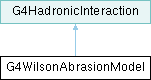
Inheritance diagram for G4WilsonAbrasionModel:

Public Member Functions

 G4WilsonAbrasionModel (G4bool useAblation1=false)
 G4WilsonAbrasionModel (G4ExcitationHandler *)
 ~G4WilsonAbrasionModel ()
 G4WilsonAbrasionModel (const G4WilsonAbrasionModel &right)=delete
const G4WilsonAbrasionModeloperator= (G4WilsonAbrasionModel &right)=delete
virtual G4HadFinalStateApplyYourself (const G4HadProjectile &, G4Nucleus &)
void SetVerboseLevel (G4int)
void SetUseAblation (G4bool)
G4bool GetUseAblation ()
void SetConserveMomentum (G4bool)
G4bool GetConserveMomentum ()
void SetExcitationHandler (G4ExcitationHandler *)
G4ExcitationHandlerGetExcitationHandler ()
virtual void ModelDescription (std::ostream &) const
Public Member Functions inherited from G4HadronicInteraction
 G4HadronicInteraction (const G4String &modelName="HadronicModel")
virtual ~G4HadronicInteraction ()
virtual G4double SampleInvariantT (const G4ParticleDefinition *p, G4double plab, G4int Z, G4int A)
virtual G4bool IsApplicable (const G4HadProjectile &aTrack, G4Nucleus &targetNucleus)
G4double GetMinEnergy () const
G4double GetMinEnergy (const G4Material *aMaterial, const G4Element *anElement) const
void SetMinEnergy (G4double anEnergy)
void SetMinEnergy (G4double anEnergy, const G4Element *anElement)
void SetMinEnergy (G4double anEnergy, const G4Material *aMaterial)
G4double GetMaxEnergy () const
G4double GetMaxEnergy (const G4Material *aMaterial, const G4Element *anElement) const
void SetMaxEnergy (const G4double anEnergy)
void SetMaxEnergy (G4double anEnergy, const G4Element *anElement)
void SetMaxEnergy (G4double anEnergy, const G4Material *aMaterial)
G4int GetVerboseLevel () const
void SetVerboseLevel (G4int value)
const G4StringGetModelName () const
void DeActivateFor (const G4Material *aMaterial)
void ActivateFor (const G4Material *aMaterial)
void DeActivateFor (const G4Element *anElement)
void ActivateFor (const G4Element *anElement)
G4bool IsBlocked (const G4Material *aMaterial) const
G4bool IsBlocked (const G4Element *anElement) const
void SetRecoilEnergyThreshold (G4double val)
G4double GetRecoilEnergyThreshold () const
virtual const std::pair< G4double, G4doubleGetFatalEnergyCheckLevels () const
virtual std::pair< G4double, G4doubleGetEnergyMomentumCheckLevels () const
void SetEnergyMomentumCheckLevels (G4double relativeLevel, G4double absoluteLevel)
virtual void BuildPhysicsTable (const G4ParticleDefinition &)
virtual void InitialiseModel ()
 G4HadronicInteraction (const G4HadronicInteraction &right)=delete
const G4HadronicInteractionoperator= (const G4HadronicInteraction &right)=delete
G4bool operator== (const G4HadronicInteraction &right) const =delete
G4bool operator!= (const G4HadronicInteraction &right) const =delete

Additional Inherited Members

Protected Member Functions inherited from G4HadronicInteraction
void SetModelName (const G4String &nam)
G4bool IsBlocked () const
void Block ()
Protected Attributes inherited from G4HadronicInteraction
G4HadFinalState theParticleChange
G4int verboseLevel
G4double theMinEnergy
G4double theMaxEnergy
G4bool isBlocked

Detailed Description

Definition at line 77 of file G4WilsonAbrasionModel.hh.

Constructor & Destructor Documentation

◆ G4WilsonAbrasionModel() [1/3]

G4WilsonAbrasionModel::G4WilsonAbrasionModel ( G4bool useAblation1 = false)

Definition at line 117 of file G4WilsonAbrasionModel.cc.

118 : G4HadronicInteraction("G4WilsonAbrasion"), secID(-1)
119{
120 // Send message to stdout to advise that the G4Abrasion model is being used.
121 PrintWelcomeMessage();
122
123 // Set the default verbose level to 0 - no output.
124 verboseLevel = 0;
125 useAblation = useAblation1;
126 theAblation = nullptr;
127
128 // No de-excitation handler has been supplied - define the default handler.
129
130 theExcitationHandler = new G4ExcitationHandler();
131 if (useAblation)
132 {
133 theAblation = new G4WilsonAblationModel;
134 theAblation->SetVerboseLevel(verboseLevel);
135 theExcitationHandler->SetEvaporation(theAblation, true);
136 }
137
138 // Set the minimum and maximum range for the model (despite nomanclature,
139 // this is in energy per nucleon number).
140
141 SetMinEnergy(70.0*MeV);
142 SetMaxEnergy(10.1*GeV);
143 isBlocked = false;
144
145 // npK, when mutiplied by the nuclear Fermi momentum, determines the range of
146 // momentum over which the secondary nucleon momentum is sampled.
147
148 r0sq = 0.0;
149 npK = 5.0;
150 B = 10.0 * MeV;
151 third = 1.0 / 3.0;
152 fradius = 0.99;
153 conserveEnergy = false;
154 conserveMomentum = true;
155
156 // Creator model ID for the secondaries created by this model
157 secID = G4PhysicsModelCatalog::GetModelID( "model_" + GetModelName() );
158}
void SetMinEnergy(G4double anEnergy)
G4HadronicInteraction(const G4String &modelName="HadronicModel")
const G4String & GetModelName() const
void SetMaxEnergy(const G4double anEnergy)
static G4int GetModelID(const G4int modelIndex)

Referenced by G4WilsonAbrasionModel(), and operator=().

◆ G4WilsonAbrasionModel() [2/3]

G4WilsonAbrasionModel::G4WilsonAbrasionModel ( G4ExcitationHandler * aExcitationHandler)

Definition at line 172 of file G4WilsonAbrasionModel.cc.

172 :
173 G4HadronicInteraction("G4WilsonAbrasion"), secID(-1)
174{
175// Send message to stdout to advise that the G4Abrasion model is being used.
176
177 PrintWelcomeMessage();
178
179// Set the default verbose level to 0 - no output.
180
181 verboseLevel = 0;
182
183 theAblation = nullptr; //A.R. 26-Jul-2012 Coverity fix.
184 useAblation = false; //A.R. 14-Aug-2012 Coverity fix.
185
186//
187// The user is able to provide the excitation handler as well as an argument
188// which is provided in this instantiation is used to determine
189// whether the spectators of the interaction are free following the abrasion.
190//
191 theExcitationHandler = aExcitationHandler;
192//
193//
194// Set the minimum and maximum range for the model (despite nomanclature, this
195// is in energy per nucleon number).
196//
197 SetMinEnergy(70.0*MeV);
198 SetMaxEnergy(10.1*GeV);
199 isBlocked = false;
200//
201//
202// npK, when mutiplied by the nuclear Fermi momentum, determines the range of
203// momentum over which the secondary nucleon momentum is sampled.
204//
205 r0sq = 0.0;
206 npK = 5.0;
207 B = 10.0 * MeV;
208 third = 1.0 / 3.0;
209 fradius = 0.99;
210 conserveEnergy = false;
211 conserveMomentum = true;
212
213 // Creator model ID for the secondaries created by this model
214 secID = G4PhysicsModelCatalog::GetModelID( "model_" + GetModelName() );
215}

◆ ~G4WilsonAbrasionModel()

G4WilsonAbrasionModel::~G4WilsonAbrasionModel ( )

Definition at line 218 of file G4WilsonAbrasionModel.cc.

219{
220 delete theExcitationHandler;
221}

◆ G4WilsonAbrasionModel() [3/3]

G4WilsonAbrasionModel::G4WilsonAbrasionModel ( const G4WilsonAbrasionModel & right)
delete

Member Function Documentation

◆ ApplyYourself()

G4HadFinalState * G4WilsonAbrasionModel::ApplyYourself ( const G4HadProjectile & theTrack,
G4Nucleus & theTarget )
virtual

Reimplemented from G4HadronicInteraction.

Definition at line 224 of file G4WilsonAbrasionModel.cc.

226{
227//
228//
229// The secondaries will be returned in G4HadFinalState &theParticleChange -
230// initialise this. The original track will always be discontinued and
231// secondaries followed.
232//
233 theParticleChange.Clear();
234 theParticleChange.SetStatusChange(stopAndKill);
235//
236//
237// Get relevant information about the projectile and target (A, Z, energy/nuc,
238// momentum, etc).
239//
240 const G4ParticleDefinition *definitionP = theTrack.GetDefinition();
241 const G4double AP = definitionP->GetBaryonNumber();
242 const G4double ZP = definitionP->GetPDGCharge();
243 G4LorentzVector pP = theTrack.Get4Momentum();
244 G4double E = theTrack.GetKineticEnergy()/AP;
245 G4double AT = theTarget.GetA_asInt();
246 G4double ZT = theTarget.GetZ_asInt();
247 G4double TotalEPre = theTrack.GetTotalEnergy() +
248 theTarget.AtomicMass(AT, ZT) + theTarget.GetEnergyDeposit();
249 G4double TotalEPost = 0.0;
250//
251//
252// Determine the radii of the projectile and target nuclei.
253//
254 G4WilsonRadius aR;
255 G4double rP = aR.GetWilsonRadius(AP);
256 G4double rT = aR.GetWilsonRadius(AT);
257 G4double rPsq = rP * rP;
258 G4double rTsq = rT * rT;
259 if (verboseLevel >= 2)
260 {
261 G4cout <<"########################################"
262 <<"########################################"
263 <<G4endl;
264 G4cout.precision(6);
265 G4cout <<"IN G4WilsonAbrasionModel" <<G4endl;
266 G4cout <<"Initial projectile A=" <<AP
267 <<", Z=" <<ZP
268 <<", radius = " <<rP/fermi <<" fm"
269 <<G4endl;
270 G4cout <<"Initial target A=" <<AT
271 <<", Z=" <<ZT
272 <<", radius = " <<rT/fermi <<" fm"
273 <<G4endl;
274 G4cout <<"Projectile momentum and Energy/nuc = " <<pP <<" ," <<E <<G4endl;
275 }
276//
277//
278// The following variables are used to determine the impact parameter in the
279// near-field (i.e. taking into consideration the electrostatic repulsion).
280//
281 G4double rm = ZP * ZT * elm_coupling / (E * AP);
282 G4double r = 0.0;
283 G4double rsq = 0.0;
284//
285//
286// Initialise some of the variables which wll be used to calculate the chord-
287// length for nucleons in the projectile and target, and hence calculate the
288// number of abraded nucleons and the excitation energy.
289//
290 G4NuclearAbrasionGeometry *theAbrasionGeometry = nullptr;
291 G4double CT = 0.0;
292 G4double F = 0.0;
293 G4int Dabr = 0;
294//
295//
296// The following loop is performed until the number of nucleons which are
297// abraded by the process is >1, i.e. an interaction MUST occur.
298//
299 G4bool skipInteraction = false; // It will be set true if the two nuclei fail to collide
300 const G4int maxNumberOfLoops = 1000;
301 G4int loopCounter = -1;
302 while (Dabr == 0 && ++loopCounter < maxNumberOfLoops) /* Loop checking, 07.08.2015, A.Ribon */
303 {
304//
305//
306// Sample the impact parameter. For the moment, this class takes account of
307// electrostatic effects on the impact parameter, but (like HZETRN AND NUCFRG2)
308// does not make any correction for the effects of nuclear-nuclear repulsion.
309//
310 G4double rPT = rP + rT;
311 G4double rPTsq = rPT * rPT;
312//
313//
314// This is a "catch" to make sure we don't go into an infinite loop because the
315// energy is too low to overcome nuclear repulsion. PRT 20091023. If the
316// value of rm < fradius * rPT then we're unlikely to sample a small enough
317// impact parameter (energy of incident particle is too low).
318//
319 if (rm >= fradius * rPT) {
320 skipInteraction = true;
321 }
322//
323//
324// Now sample impact parameter until the criterion is met that projectile
325// and target overlap, but repulsion is taken into consideration.
326//
327 G4int evtcnt = 0;
328 r = 1.1 * rPT;
329 while (r > rPT && ++evtcnt < 1000) /* Loop checking, 07.08.2015, A.Ribon */
330 {
331 G4double bsq = rPTsq * G4UniformRand();
332 r = (rm + std::sqrt(rm*rm + 4.0*bsq)) / 2.0;
333 }
334//
335//
336// We've tried to sample this 1000 times, but failed.
337//
338 if (evtcnt >= 1000) {
339 skipInteraction = true;
340 }
341
342 rsq = r * r;
343//
344//
345// Now determine the chord-length through the target nucleus.
346//
347 if (rT > rP)
348 {
349 G4double x = (rPsq + rsq - rTsq) / 2.0 / r;
350 if (x > 0.0) CT = 2.0 * std::sqrt(rTsq - x*x);
351 else CT = 2.0 * std::sqrt(rTsq - rsq);
352 }
353 else
354 {
355 G4double x = (rTsq + rsq - rPsq) / 2.0 / r;
356 if (x > 0.0) CT = 2.0 * std::sqrt(rTsq - x*x);
357 else CT = 2.0 * rT;
358 }
359//
360//
361// Determine the number of abraded nucleons. Note that the mean number of
362// abraded nucleons is used to sample the Poisson distribution. The Poisson
363// distribution is sampled only ten times with the current impact parameter,
364// and if it fails after this to find a case for which the number of abraded
365// nucleons >1, the impact parameter is re-sampled.
366//
367 delete theAbrasionGeometry;
368 theAbrasionGeometry = new G4NuclearAbrasionGeometry(AP,AT,r);
369 F = theAbrasionGeometry->F();
370 G4double lambda = 16.6*fermi / G4Pow::GetInstance()->powA(E/MeV,0.26);
371 G4double Mabr = F * AP * (1.0 - G4Exp(-CT/lambda));
372 G4long n = 0;
373 for (G4int i = 0; i<10; ++i)
374 {
375 n = G4Poisson(Mabr);
376 if (n > 0)
377 {
378 if (n>AP) Dabr = (G4int) AP;
379 else Dabr = (G4int) n;
380 break;
381 }
382 }
383 } // End of while loop
384
385 if ( loopCounter >= maxNumberOfLoops || skipInteraction ) {
386 // Assume nuclei do not collide and return unchanged primary.
387 theParticleChange.SetStatusChange(isAlive);
388 theParticleChange.SetEnergyChange(theTrack.GetKineticEnergy());
389 theParticleChange.SetMomentumChange(theTrack.Get4Momentum().vect().unit());
390 if (verboseLevel >= 2) {
391 G4cout <<"Particle energy too low to overcome repulsion." <<G4endl;
392 G4cout <<"Event rejected and original track maintained" <<G4endl;
393 G4cout <<"########################################"
394 <<"########################################"
395 <<G4endl;
396 }
397 delete theAbrasionGeometry;
398 return &theParticleChange;
399 }
400
401 if (verboseLevel >= 2)
402 {
403 G4cout <<G4endl;
404 G4cout <<"Impact parameter = " <<r/fermi <<" fm" <<G4endl;
405 G4cout <<"# Abraded nucleons = " <<Dabr <<G4endl;
406 }
407//
408//
409// The number of abraded nucleons must be no greater than the number of
410// nucleons in either the projectile or the target. If AP - Dabr < 2 or
411// AT - Dabr < 2 then either we have only a nucleon left behind in the
412// projectile/target or we've tried to abrade too many nucleons - and Dabr
413// should be limited.
414//
415 if (AP - (G4double) Dabr < 2.0) Dabr = (G4int) AP;
416 if (AT - (G4double) Dabr < 2.0) Dabr = (G4int) AT;
417//
418//
419// Determine the abraded secondary nucleons from the projectile. *fragmentP
420// is a pointer to the prefragment from the projectile and nSecP is the number
421// of nucleons in theParticleChange which have been abraded. The total energy
422// from these is determined.
423//
424 G4ThreeVector boost = pP.findBoostToCM();
425 G4Fragment *fragmentP = GetAbradedNucleons (Dabr, AP, ZP, rP);
426 G4int nSecP = (G4int)theParticleChange.GetNumberOfSecondaries();
427 G4int i = 0;
428 for (i=0; i<nSecP; ++i)
429 {
430 TotalEPost += theParticleChange.GetSecondary(i)->
431 GetParticle()->GetTotalEnergy();
432 }
433//
434//
435// Determine the number of spectators in the interaction region for the
436// projectile.
437//
438 G4int DspcP = (G4int) (AP*F) - Dabr;
439 if (DspcP <= 0) DspcP = 0;
440 else if (DspcP > AP-Dabr) DspcP = ((G4int) AP) - Dabr;
441//
442//
443// Determine excitation energy associated with excess surface area of the
444// projectile (EsP) and the excitation due to scattering of nucleons which are
445// retained within the projectile (ExP). Add the total energy from the excited
446// nucleus to the total energy of the secondaries.
447//
448 G4bool excitationAbsorbedByProjectile = false;
449 if (fragmentP != nullptr)
450 {
451 G4double EsP = theAbrasionGeometry->GetExcitationEnergyOfProjectile();
452 G4double ExP = 0.0;
453 if (Dabr < AT)
454 excitationAbsorbedByProjectile = G4UniformRand() < 0.5;
455 if (excitationAbsorbedByProjectile)
456 ExP = GetNucleonInducedExcitation(rP, rT, r);
457 G4double xP = EsP + ExP;
458 if (xP > B*(AP-Dabr)) xP = B*(AP-Dabr);
459 G4LorentzVector lorentzVector = fragmentP->GetMomentum();
460 lorentzVector.setE(lorentzVector.e()+xP);
461 fragmentP->SetMomentum(lorentzVector);
462 TotalEPost += lorentzVector.e();
463 }
464 G4double EMassP = TotalEPost;
465//
466//
467// Determine the abraded secondary nucleons from the target. Note that it's
468// assumed that the same number of nucleons are abraded from the target as for
469// the projectile, and obviously no boost is applied to the products. *fragmentT
470// is a pointer to the prefragment from the target and nSec is the total number
471// of nucleons in theParticleChange which have been abraded. The total energy
472// from these is determined.
473//
474 G4Fragment *fragmentT = GetAbradedNucleons (Dabr, AT, ZT, rT);
475 G4int nSec = (G4int)theParticleChange.GetNumberOfSecondaries();
476 for (i=nSecP; i<nSec; ++i)
477 {
478 TotalEPost += theParticleChange.GetSecondary(i)->
479 GetParticle()->GetTotalEnergy();
480 }
481//
482//
483// Determine the number of spectators in the interaction region for the
484// target.
485//
486 G4int DspcT = (G4int) (AT*F) - Dabr;
487 if (DspcT <= 0) DspcT = 0;
488 else if (DspcT > AP-Dabr) DspcT = ((G4int) AT) - Dabr;
489//
490//
491// Determine excitation energy associated with excess surface area of the
492// target (EsT) and the excitation due to scattering of nucleons which are
493// retained within the target (ExT). Add the total energy from the excited
494// nucleus to the total energy of the secondaries.
495//
496 if (fragmentT != nullptr)
497 {
498 G4double EsT = theAbrasionGeometry->GetExcitationEnergyOfTarget();
499 G4double ExT = 0.0;
500 if (!excitationAbsorbedByProjectile)
501 ExT = GetNucleonInducedExcitation(rT, rP, r);
502 G4double xT = EsT + ExT;
503 if (xT > B*(AT-Dabr)) xT = B*(AT-Dabr);
504 G4LorentzVector lorentzVector = fragmentT->GetMomentum();
505 lorentzVector.setE(lorentzVector.e()+xT);
506 fragmentT->SetMomentum(lorentzVector);
507 TotalEPost += lorentzVector.e();
508 }
509//
510//
511// Now determine the difference between the pre and post interaction
512// energy - this will be used to determine the Lorentz boost if conservation
513// of energy is to be imposed/attempted.
514//
515 G4double deltaE = TotalEPre - TotalEPost;
516 if (deltaE > 0.0 && conserveEnergy)
517 {
518 G4double beta = std::sqrt(1.0 - EMassP*EMassP/G4Pow::GetInstance()->powN(deltaE+EMassP,2));
519 boost = boost / boost.mag() * beta;
520 }
521//
522//
523// Now boost the secondaries from the projectile.
524//
525 G4ThreeVector pBalance = pP.vect();
526 for (i=0; i<nSecP; ++i)
527 {
528 G4DynamicParticle *dynamicP = theParticleChange.GetSecondary(i)->
529 GetParticle();
530 G4LorentzVector lorentzVector = dynamicP->Get4Momentum();
531 lorentzVector.boost(-boost);
532 dynamicP->Set4Momentum(lorentzVector);
533 pBalance -= lorentzVector.vect();
534 }
535//
536//
537// Set the boost for the projectile prefragment. This is now based on the
538// conservation of momentum. However, if the user selected momentum of the
539// prefragment is not to be conserved this simply boosted to the velocity of the
540// original projectile times the ratio of the unexcited to the excited mass
541// of the prefragment (the excitation increases the effective mass of the
542// prefragment, and therefore modifying the boost is an attempt to prevent
543// the momentum of the prefragment being excessive).
544//
545 if (fragmentP != nullptr)
546 {
547 G4LorentzVector lorentzVector = fragmentP->GetMomentum();
548 G4double fragmentM = lorentzVector.m();
549 if (conserveMomentum)
550 fragmentP->SetMomentum
551 (G4LorentzVector(pBalance,std::sqrt(pBalance.mag2()+fragmentM*fragmentM+1.0*eV*eV)));
552 else
553 {
554 G4double fragmentGroundStateM = fragmentP->GetGroundStateMass();
555 fragmentP->SetMomentum(lorentzVector.boost(-boost * fragmentGroundStateM/fragmentM));
556 }
557 }
558//
559//
560// Output information to user if verbose information requested.
561//
562 if (verboseLevel >= 2)
563 {
564 G4cout <<G4endl;
565 G4cout <<"-----------------------------------" <<G4endl;
566 G4cout <<"Secondary nucleons from projectile:" <<G4endl;
567 G4cout <<"-----------------------------------" <<G4endl;
568 G4cout.precision(7);
569 for (i=0; i<nSecP; ++i)
570 {
571 G4cout <<"Particle # " <<i <<G4endl;
572 theParticleChange.GetSecondary(i)->GetParticle()->DumpInfo();
573 G4DynamicParticle *dyn = theParticleChange.GetSecondary(i)->GetParticle();
574 G4cout <<"New nucleon (P) " <<dyn->GetDefinition()->GetParticleName()
575 <<" : " <<dyn->Get4Momentum()
576 <<G4endl;
577 }
578 G4cout <<"---------------------------" <<G4endl;
579 G4cout <<"The projectile prefragment:" <<G4endl;
580 G4cout <<"---------------------------" <<G4endl;
581 if (fragmentP != nullptr)
582 G4cout <<*fragmentP <<G4endl;
583 else
584 G4cout <<"(No residual prefragment)" <<G4endl;
585 G4cout <<G4endl;
586 G4cout <<"-------------------------------" <<G4endl;
587 G4cout <<"Secondary nucleons from target:" <<G4endl;
588 G4cout <<"-------------------------------" <<G4endl;
589 G4cout.precision(7);
590 for (i=nSecP; i<nSec; ++i)
591 {
592 G4cout <<"Particle # " <<i <<G4endl;
593 theParticleChange.GetSecondary(i)->GetParticle()->DumpInfo();
594 G4DynamicParticle *dyn = theParticleChange.GetSecondary(i)->GetParticle();
595 G4cout <<"New nucleon (T) " <<dyn->GetDefinition()->GetParticleName()
596 <<" : " <<dyn->Get4Momentum()
597 <<G4endl;
598 }
599 G4cout <<"-----------------------" <<G4endl;
600 G4cout <<"The target prefragment:" <<G4endl;
601 G4cout <<"-----------------------" <<G4endl;
602 if (fragmentT != nullptr)
603 G4cout <<*fragmentT <<G4endl;
604 else
605 G4cout <<"(No residual prefragment)" <<G4endl;
606 }
607//
608//
609// Now we can decay the nuclear fragments if present. The secondaries are
610// collected and boosted as well. This is performed first for the projectile...
611//
612 if (fragmentP !=nullptr)
613 {
614 G4ReactionProductVector *products = nullptr;
615 // if (fragmentP->GetZ_asInt() != fragmentP->GetA_asInt())
616 products = theExcitationHandler->BreakItUp(*fragmentP);
617 // else
618 // products = theExcitationHandlerx->BreakItUp(*fragmentP);
619 delete fragmentP;
620 fragmentP = nullptr;
621
622 G4ReactionProductVector::iterator iter;
623 for (iter = products->begin(); iter != products->end(); ++iter)
624 {
625 G4DynamicParticle *secondary =
626 new G4DynamicParticle((*iter)->GetDefinition(),
627 (*iter)->GetTotalEnergy(), (*iter)->GetMomentum());
628 theParticleChange.AddSecondary (secondary, secID);
629 G4String particleName = (*iter)->GetDefinition()->GetParticleName();
630 delete (*iter); // get rid of leftover particle def!
631 if (verboseLevel >= 2 && particleName.find("[",0) < particleName.size())
632 {
633 G4cout <<"------------------------" <<G4endl;
634 G4cout <<"The projectile fragment:" <<G4endl;
635 G4cout <<"------------------------" <<G4endl;
636 G4cout <<" fragmentP = " <<particleName
637 <<" Energy = " <<secondary->GetKineticEnergy()
638 <<G4endl;
639 }
640 }
641 delete products;
642 }
643//
644//
645// Now decay the target nucleus - no boost is applied since in this
646// approximation it is assumed that there is negligible momentum transfer from
647// the projectile.
648//
649 if (fragmentT != nullptr)
650 {
651 G4ReactionProductVector *products = nullptr;
652 // if (fragmentT->GetZ_asInt() != fragmentT->GetA_asInt())
653 products = theExcitationHandler->BreakItUp(*fragmentT);
654 // else
655 // products = theExcitationHandlerx->BreakItUp(*fragmentT);
656 // delete fragmentT;
657 fragmentT = nullptr;
658
659 G4ReactionProductVector::iterator iter;
660 for (iter = products->begin(); iter != products->end(); ++iter)
661 {
662 G4DynamicParticle *secondary =
663 new G4DynamicParticle((*iter)->GetDefinition(),
664 (*iter)->GetTotalEnergy(), (*iter)->GetMomentum());
665 theParticleChange.AddSecondary (secondary, secID);
666 G4String particleName = (*iter)->GetDefinition()->GetParticleName();
667 delete (*iter); // get rid of leftover particle def!
668 if (verboseLevel >= 2 && particleName.find("[",0) < particleName.size())
669 {
670 G4cout <<"--------------------" <<G4endl;
671 G4cout <<"The target fragment:" <<G4endl;
672 G4cout <<"--------------------" <<G4endl;
673 G4cout <<" fragmentT = " <<particleName
674 <<" Energy = " <<secondary->GetKineticEnergy()
675 <<G4endl;
676 }
677 }
678 delete products;
679 }
680
681 if (verboseLevel >= 2)
682 G4cout <<"########################################"
683 <<"########################################"
684 <<G4endl;
685
686 delete theAbrasionGeometry;
687 return &theParticleChange;
688}
G4double G4Exp(G4double initial_x)
Exponential Function double precision.
Definition G4Exp.hh:132
@ isAlive
@ stopAndKill
CLHEP::HepLorentzVector G4LorentzVector
G4long G4Poisson(G4double mean)
Definition G4Poisson.hh:50
std::vector< G4ReactionProduct * > G4ReactionProductVector
CLHEP::Hep3Vector G4ThreeVector
double G4double
Definition G4Types.hh:83
long G4long
Definition G4Types.hh:87
bool G4bool
Definition G4Types.hh:86
int G4int
Definition G4Types.hh:85
#define G4endl
Definition G4ios.hh:67
G4GLOB_DLL std::ostream G4cout
#define G4UniformRand()
Definition Randomize.hh:52
Hep3Vector unit() const
double mag2() const
double mag() const
HepLorentzVector & boost(double, double, double)
Hep3Vector vect() const
Hep3Vector findBoostToCM() const
G4ParticleDefinition * GetDefinition() const
G4LorentzVector Get4Momentum() const
G4double GetKineticEnergy() const
void Set4Momentum(const G4LorentzVector &momentum)
G4double GetGroundStateMass() const
const G4LorentzVector & GetMomentum() const
void SetMomentum(const G4LorentzVector &value)
const G4ParticleDefinition * GetDefinition() const
G4double GetKineticEnergy() const
const G4LorentzVector & Get4Momentum() const
G4double GetTotalEnergy() const
G4int GetA_asInt() const
Definition G4Nucleus.hh:78
G4int GetZ_asInt() const
Definition G4Nucleus.hh:84
G4double AtomicMass(const G4double A, const G4double Z, const G4int numberOfLambdas=0) const
Definition G4Nucleus.cc:369
G4double GetEnergyDeposit()
Definition G4Nucleus.hh:159
const G4String & GetParticleName() const
static G4Pow * GetInstance()
Definition G4Pow.cc:41
G4double powA(G4double A, G4double y) const
Definition G4Pow.hh:230
G4double GetWilsonRadius(G4double A)

◆ GetConserveMomentum()

G4bool G4WilsonAbrasionModel::GetConserveMomentum ( )
inline

Definition at line 138 of file G4WilsonAbrasionModel.hh.

139 {return conserveMomentum;}

◆ GetExcitationHandler()

G4ExcitationHandler * G4WilsonAbrasionModel::GetExcitationHandler ( )
inline

Definition at line 123 of file G4WilsonAbrasionModel.hh.

124 {return theExcitationHandler;}

◆ GetUseAblation()

G4bool G4WilsonAbrasionModel::GetUseAblation ( )
inline

Definition at line 126 of file G4WilsonAbrasionModel.hh.

127 {return useAblation;}

◆ ModelDescription()

void G4WilsonAbrasionModel::ModelDescription ( std::ostream & outFile) const
virtual

Reimplemented from G4HadronicInteraction.

Definition at line 160 of file G4WilsonAbrasionModel.cc.

161{
162 outFile << "G4WilsonAbrasionModel is a macroscopic treatment of\n"
163 << "nucleus-nucleus collisions using simple geometric arguments.\n"
164 << "The smaller projectile nucleus gouges out a part of the larger\n"
165 << "target nucleus, leaving a residual nucleus and a fireball\n"
166 << "region where the projectile and target intersect. The fireball"
167 << "is then treated as a highly excited nuclear fragment. This\n"
168 << "model is based on the NUCFRG2 model and is valid for all\n"
169 << "projectile energies between 70 MeV/n and 10.1 GeV/n. \n";
170}

◆ operator=()

const G4WilsonAbrasionModel & G4WilsonAbrasionModel::operator= ( G4WilsonAbrasionModel & right)
delete

◆ SetConserveMomentum()

void G4WilsonAbrasionModel::SetConserveMomentum ( G4bool conserveMomentum1)
inline

Definition at line 135 of file G4WilsonAbrasionModel.hh.

136 {conserveMomentum = conserveMomentum1;}

◆ SetExcitationHandler()

void G4WilsonAbrasionModel::SetExcitationHandler ( G4ExcitationHandler * aExcitationHandler)
inline

Definition at line 120 of file G4WilsonAbrasionModel.hh.

121 {theExcitationHandler = aExcitationHandler;}

◆ SetUseAblation()

void G4WilsonAbrasionModel::SetUseAblation ( G4bool useAblation1)

Definition at line 857 of file G4WilsonAbrasionModel.cc.

858{
859 if (useAblation != useAblation1)
860 {
861 useAblation = useAblation1;
862 if (useAblation)
863 {
864 theAblation = new G4WilsonAblationModel;
865 theAblation->SetVerboseLevel(verboseLevel);
866 theExcitationHandler->SetEvaporation(theAblation);
867 }
868 else
869 {
870 delete theExcitationHandler;
871 theAblation = nullptr;
872 theExcitationHandler = new G4ExcitationHandler();
873 }
874 }
875 return;
876}

◆ SetVerboseLevel()

void G4WilsonAbrasionModel::SetVerboseLevel ( G4int verboseLevel1)
inline

Definition at line 141 of file G4WilsonAbrasionModel.hh.

142{
143 verboseLevel = verboseLevel1;
144 if (useAblation) theAblation->SetVerboseLevel(verboseLevel);
145}

The documentation for this class was generated from the following files: