Loading...
Searching...
No Matches
G4EMDissociation Class Reference
#include <G4EMDissociation.hh>
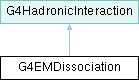
Inheritance diagram for G4EMDissociation:
Additional Inherited Members | |
| Protected Member Functions inherited from G4HadronicInteraction | |
| void | SetModelName (const G4String &nam) |
| G4bool | IsBlocked () const |
| void | Block () |
| Protected Attributes inherited from G4HadronicInteraction | |
| G4HadFinalState | theParticleChange |
| G4int | verboseLevel |
| G4double | theMinEnergy |
| G4double | theMaxEnergy |
| G4bool | isBlocked |
Detailed Description
Definition at line 78 of file G4EMDissociation.hh.
Constructor & Destructor Documentation
◆ G4EMDissociation() [1/3]
| G4EMDissociation::G4EMDissociation | ( | ) |
Definition at line 79 of file G4EMDissociation.cc.
79 :
81 secID_projectileDissociation(-1), secID_targetDissociation(-1)
82{
83 // Send message to stdout to advise that the G4EMDissociation model is being
84 // used.
85 PrintWelcomeMessage();
86
87 // No de-excitation handler has been supplied - define the default handler.
88 theExcitationHandler = new G4ExcitationHandler;
89 theExcitationHandler->SetMinEForMultiFrag(5.0*MeV);
90 handlerDefinedInternally = true;
91
92 // This EM dissociation model needs access to the cross-sections held in
93 // G4EMDissociationCrossSection.
94 dissociationCrossSection = new G4EMDissociationCrossSection;
95 thePhotonSpectrum = new G4EMDissociationSpectrum;
96
97 // Set the minimum and maximum range for the model (despite nomanclature, this
98 // is in energy per nucleon number).
99 SetMinEnergy(100.0*MeV);
100 SetMaxEnergy(500.0*GeV);
101
102 // Set the default verbose level to 0 - no output.
103 verboseLevel = 0;
104
105 // Creator model ID for the secondaries created by this model
106 secID_projectileDissociation = G4PhysicsModelCatalog::GetModelID( "model_projectile" + GetModelName() );
107 secID_targetDissociation = G4PhysicsModelCatalog::GetModelID( "model_target" + GetModelName() );
108}
void SetMinEnergy(G4double anEnergy)
Definition G4HadronicInteraction.hh:89
G4HadronicInteraction(const G4String &modelName="HadronicModel")
Definition G4HadronicInteraction.cc:41
const G4String & GetModelName() const
Definition G4HadronicInteraction.hh:115
void SetMaxEnergy(const G4double anEnergy)
Definition G4HadronicInteraction.hh:102
static G4int GetModelID(const G4int modelIndex)
Definition G4PhysicsModelCatalog.cc:709
Referenced by G4EMDissociation(), and operator=().
◆ G4EMDissociation() [2/3]
| G4EMDissociation::G4EMDissociation | ( | G4ExcitationHandler * | aExcitationHandler | ) |
Definition at line 110 of file G4EMDissociation.cc.
110 :
112 secID_projectileDissociation(-1), secID_targetDissociation(-1)
113{
114 // Send message to stdout to advise that the G4EMDissociation model is being
115 // used.
116 PrintWelcomeMessage();
117
118 theExcitationHandler = aExcitationHandler;
119 handlerDefinedInternally = false;
120
121 // This EM dissociation model needs access to the cross-sections held in
122 // G4EMDissociationCrossSection.
123 dissociationCrossSection = new G4EMDissociationCrossSection;
124 thePhotonSpectrum = new G4EMDissociationSpectrum;
125
126 // Set the minimum and maximum range for the model (despite nomanclature, this
127 // is in energy per nucleon number)
128 SetMinEnergy(100.0*MeV);
129 SetMaxEnergy(500.0*GeV);
130 verboseLevel = 0;
131
132 // Creator model ID for the secondaries created by this model
133 secID_projectileDissociation = G4PhysicsModelCatalog::GetModelID( "model_projectile" + GetModelName() );
134 secID_targetDissociation = G4PhysicsModelCatalog::GetModelID( "model_target" + GetModelName() );
135}
◆ ~G4EMDissociation()
| G4EMDissociation::~G4EMDissociation | ( | ) |
Definition at line 138 of file G4EMDissociation.cc.
138 {
139 if (handlerDefinedInternally) delete theExcitationHandler;
140 // delete dissociationCrossSection;
141 // Cross section deleted by G4CrossSectionRegistry; don't do it here
142 // Bug reported by Gong Ding in Bug Report #1339
143 delete thePhotonSpectrum;
144}
◆ G4EMDissociation() [3/3]
|
delete |
Member Function Documentation
◆ ApplyYourself()
|
virtual |
Reimplemented from G4HadronicInteraction.
Definition at line 147 of file G4EMDissociation.cc.
149{
150 // The secondaries will be returned in G4HadFinalState &theParticleChange -
151 // initialise this.
152
153 theParticleChange.Clear();
155
156 // Get relevant information about the projectile and target (A, Z) and
157 // energy/nuc, momentum, velocity, Lorentz factor and rest-mass of the
158 // projectile.
159
171
172 // Depending upon the verbosity level, output the initial information on the
173 // projectile and target
175 G4cout.precision(6);
177 <<"########################################"
178 <<G4endl;
181 <<", Z=" <<ZP
182 <<G4endl;
184 <<", Z=" <<ZT
185 <<G4endl;
187 }
188
189 // Initialise the variables which will be used with the phase-space decay and
190 // to boost the secondaries from the interaction.
191
192 G4ParticleDefinition *typeNucleon = nullptr;
193 G4ParticleDefinition *typeDaughter = nullptr;
194 G4double Eg = 0.0;
195 G4double mass = 0.0;
197
198 // Determine the cross-sections at the giant dipole and giant quadrupole
199 // resonance energies for the projectile and then target. The information is
200 // initially provided in the G4PhysicsFreeVector individually for the E1
201 // and E2 fields. These are then summed.
202
203 G4double bmin = thePhotonSpectrum->GetClosestApproach(AP, ZP, AT, ZT, b);
204 G4PhysicsFreeVector *crossSectionP = dissociationCrossSection->
205 GetCrossSectionForProjectile(AP, ZP, AT, ZT, b, bmin);
206 G4PhysicsFreeVector *crossSectionT = dissociationCrossSection->
207 GetCrossSectionForTarget(AP, ZP, AT, ZT, b, bmin);
208
209 G4double totCrossSectionP = (*crossSectionP)[0]+(*crossSectionP)[1];
210 G4double totCrossSectionT = (*crossSectionT)[0]+(*crossSectionT)[1];
211
212 // Now sample whether the interaction involved EM dissociation of the projectile
213 // or the target.
214
217
218 // It was the projectile which underwent EM dissociation. Define the Lorentz
219 // boost to be applied to the secondaries, and sample whether a proton or a
220 // neutron was ejected. Then determine the energy of the virtual gamma ray
221 // which passed from the target nucleus ... this will be used to define the
222 // excitation of the projectile.
223
224 secID = secID_projectileDissociation;
225 mass = MP;
227 GetWilsonProbabilityForProtonDissociation (AP, ZP))
228 {
231 <<G4endl;
232 typeNucleon = G4Proton::ProtonDefinition();
233 typeDaughter = G4IonTable::GetIonTable()->
235 }
236 else
237 {
240 <<G4endl;
241 typeNucleon = G4Neutron::NeutronDefinition();
242 typeDaughter = G4IonTable::GetIonTable()->
244 }
246 {
247 Eg = crossSectionP->GetLowEdgeEnergy(0);
250 }
251 else
252 {
253 Eg = crossSectionP->GetLowEdgeEnergy(1);
256 }
257
258 // We need to define a Lorentz vector with the original momentum, but total
259 // energy includes the projectile and virtual gamma. This is then used
260 // to calculate the boost required for the secondaries.
261
263 boost = pP.findBoostToCM();
264 }
265 else
266 {
267 // It was the target which underwent EM dissociation. Sample whether a
268 // proton or a neutron was ejected. Then determine the energy of the virtual
269 // gamma ray which passed from the projectile nucleus ... this will be used to
270 // define the excitation of the target.
271
272 secID = secID_targetDissociation;
273 mass = MT;
275 GetWilsonProbabilityForProtonDissociation (AT, ZT))
276 {
279 <<G4endl;
280 typeNucleon = G4Proton::ProtonDefinition();
281 typeDaughter = G4IonTable::GetIonTable()->
283 }
284 else
285 {
288 <<G4endl;
289 typeNucleon = G4Neutron::NeutronDefinition();
290 typeDaughter = G4IonTable::GetIonTable()->
292 }
294 {
295 Eg = crossSectionT->GetLowEdgeEnergy(0);
298 }
299 else
300 {
301 Eg = crossSectionT->GetLowEdgeEnergy(1);
304 }
305
306 // Add the projectile to theParticleChange, less the energy of the
307 // not-so-virtual gamma-ray. Not that at the moment, no lateral momentum
308 // is transferred between the projectile and target nuclei.
309
311 v.setMag(1.0);
312 G4DynamicParticle *changedP = new G4DynamicParticle (definitionP, v, E*AP-Eg);
313 theParticleChange.AddSecondary (changedP, secID);
315 {
317 changedP->DumpInfo();
318 }
319 }
320
321 // Perform a two-body decay based on the restmass energy of the parent and
322 // gamma-ray, and the masses of the daughters. In the frame of reference of
323 // the nucles, the angular distribution is sampled isotropically, but the
324 // the nucleon and secondary nucleus are boosted if they've come from the
325 // projectile.
326
327 G4double e = mass + Eg;
331 (e-mass1+mass2)*(e-mass1-mass2)/(4.0*e*e);
332 if (pp < 0.0) {
333 pp = 1.0*eV;
334// if (verboseLevel >`= 1)
335// {
336// G4cout <<"IN G4EMDissociation::ApplyYoursef" <<G4endl;
337// G4cout <<"Error in mass of secondaries compared with primary:" <<G4endl;
338// G4cout <<"Rest mass of primary = " <<mass <<" MeV" <<G4endl;
339// G4cout <<"Virtual gamma energy = " <<Eg <<" MeV" <<G4endl;
340// G4cout <<"Rest mass of secondary #1 = " <<mass1 <<" MeV" <<G4endl;
341// G4cout <<"Rest mass of secondary #2 = " <<mass2 <<" MeV" <<G4endl;
342// }
343 }
344 else
345 pp = std::sqrt(pp);
347 G4double sintheta = std::sqrt((1.0 - costheta)*(1.0 + costheta));
349 G4ThreeVector direction(sintheta*std::cos(phi),sintheta*std::sin(phi),costheta);
350 G4DynamicParticle *dynamicNucleon =
351 new G4DynamicParticle(typeNucleon, direction*pp);
353 G4DynamicParticle *dynamicDaughter =
354 new G4DynamicParticle(typeDaughter, -direction*pp);
356
357 // The "decay" products have to be transferred to the G4HadFinalState object.
358 // Furthermore, the residual nucleus should be de-excited.
359
360 theParticleChange.AddSecondary (dynamicNucleon, secID);
363 dynamicNucleon->DumpInfo();
364 }
365
366 G4Fragment* theFragment = new
367 G4Fragment(typeDaughter->GetBaryonNumber(),
369 dynamicDaughter->Get4Momentum());
370
373 G4cout.precision(6);
374 dynamicDaughter->DumpInfo();
377 }
378
379 G4ReactionProductVector* products =
380 theExcitationHandler->BreakItUp(*theFragment);
381 delete theFragment;
382 theFragment = NULL;
383
384 G4DynamicParticle* secondary = 0;
385 G4ReactionProductVector::iterator iter;
386 for (iter = products->begin(); iter != products->end(); ++iter) {
387 secondary = new G4DynamicParticle((*iter)->GetDefinition(),
388 (*iter)->GetTotalEnergy(), (*iter)->GetMomentum());
389 theParticleChange.AddSecondary (secondary, secID);
390 }
391 delete products;
392
393 delete crossSectionP;
394 delete crossSectionT;
395
398 <<"########################################"
399 <<G4endl;
400
402}
std::vector< G4ReactionProduct * > G4ReactionProductVector
Definition G4ReactionProductVector.hh:43
G4GLOB_DLL std::ostream G4cout
double mag2() const
HepLorentzVector & boost(double, double, double)
Definition LorentzVector.cc:55
Hep3Vector vect() const
void setE(double)
Hep3Vector findBoostToCM() const
Definition LorentzVectorK.cc:220
G4LorentzVector Get4Momentum() const
void Set4Momentum(const G4LorentzVector &momentum)
Definition G4DynamicParticle.cc:346
const G4ParticleDefinition * GetDefinition() const
Definition G4HadProjectile.hh:86
const G4LorentzVector & Get4Momentum() const
Definition G4HadProjectile.hh:91
G4HadFinalState theParticleChange
Definition G4HadronicInteraction.hh:172
static G4double GetNuclearMass(const G4double A, const G4double Z)
Definition G4NucleiProperties.cc:49
G4double GetPDGCharge() const
Definition G4ParticleDefinition.hh:100
G4int GetBaryonNumber() const
Definition G4ParticleDefinition.hh:121
G4double GetLowEdgeEnergy(const std::size_t index) const
◆ operator=()
|
delete |
The documentation for this class was generated from the following files: