#include <Issue.h>
Public Member Functions | |
| Issue () | |
| Issue (const Issue &issue) | |
| Issue (const string_map_type &values) | |
| Issue (const Context &context, severity_t s, const std::string &message) | |
| Issue (const Context &context, severity_t s, const std::exception *cause) | |
| virtual | ~Issue () throw () |
| Issue * | clone () const |
| const Issue * | cause () const throw () |
| return the cause Issue of this Issue | |
| void | cause (const std::exception *cause=0) |
| Initialises the cause field. | |
| operator std::string () const | |
| Converts the issue into a string. | |
| Issue | operator= (const Issue &issue) |
| Affectation operator. | |
| bool | operator== (const Issue &other) const throw () |
| Equality operator. | |
| const std::string & | operator[] (const std::string &key) const throw () |
| const std::string & | get_value (const std::string &key, const std::string &def) const throw () |
| Reads the property list. | |
| const std::string & | get_value (const std::string &key) const throw () |
| int | get_int_value (const std::string &key, int def=0) const throw () |
| Get a value of the table as an integer. | |
| long | get_long_value (const std::string &key, long def=0) const throw () |
| Get a value of the table as a long integer. | |
| double | get_double_value (const std::string key, double def) const throw () |
| Get a value of the table as double. | |
| void | set_value (const std::string &key, uint8_t value) throw () |
| Sets a value 8 bit unsigned. | |
| void | set_value (const std::string &key, uint16_t value) throw () |
| void | set_value (const std::string &key, uint32_t value) throw () |
| void | set_value (const std::string &key, uint64_t value) throw () |
| void | set_value (const std::string &key, int8_t value) throw () |
| void | set_value (const std::string &key, int16_t value) throw () |
| void | set_value (const std::string &key, int32_t value) throw () |
| void | set_value (const std::string &key, int64_t value) throw () |
| void | set_value (const std::string &key, double value) throw () |
| Sets a value (double float). | |
| void | set_value (const std::string &key, const std::string &value) throw () |
| Sets a value (string). | |
| void | set_value (const std::string &key, const char *value) throw () |
| Sets a value (c-string). | |
| void | set_value (const std::string &key, const void *ptr) throw () |
| int | values_number () const |
| How many key / values. | |
| virtual const char * | get_class_name () const throw () |
| Get key for class (used for serialisation). | |
| const string_map_type * | get_value_table () const |
| extract value table | |
| severity_t | severity () const throw () |
| severity_t of the issue | |
| void | severity (severity_t s) |
| sets the severity_t of the issue | |
| bool | is_error () |
| is the issue an error (or fatal). | |
| std::string | severity_message () const |
| message associated with the severity_t of the issue | |
| void | responsibility (responsibility_t r) |
| set the responsability of the issue | |
| responsibility_t | responsibility () const throw () |
| get the responsability level of the issue | |
| void | transience (bool tr) |
| sets if the issue is transient | |
| int | transience () const throw () |
| is the issue transient | |
| const std::string & | human_description () const throw () |
| Human description message. | |
| const char * | what () const throw () |
| Human description message. | |
| const std::string & | message () const throw () |
| Message. | |
| virtual int | exit_value () const throw () |
| value to pass to exit | |
| void | add_qualifier (const std::string &qualif) |
| adds a qualifier to the issue | |
| std::vector< std::string > | qualifiers () const |
| return array of qualifiers | |
| Issue () | |
| Issue (const Issue &issue) | |
| Issue (const string_map_type &values) | |
| Issue (const Context &context, severity_t s, const std::string &message) | |
| Issue (const Context &context, severity_t s, const std::exception *cause) | |
| virtual | ~Issue () throw () |
| Issue * | clone () const |
| const Issue * | cause () const throw () |
| return the cause Issue of this Issue | |
| void | cause (const std::exception *cause=0) |
| Initialises the cause field. | |
| operator std::string () const | |
| Converts the issue into a string. | |
| Issue | operator= (const Issue &issue) |
| Affectation operator. | |
| bool | operator== (const Issue &other) const throw () |
| Equality operator. | |
| const std::string & | operator[] (const std::string &key) const throw () |
| const std::string & | get_value (const std::string &key, const std::string &def) const throw () |
| Reads the property list. | |
| const std::string & | get_value (const std::string &key) const throw () |
| int | get_int_value (const std::string &key, int def=0) const throw () |
| Get a value of the table as an integer. | |
| long | get_long_value (const std::string &key, long def=0) const throw () |
| Get a value of the table as a long integer. | |
| double | get_double_value (const std::string key, double def) const throw () |
| Get a value of the table as double. | |
| void | set_value (const std::string &key, uint8_t value) throw () |
| Sets a value 8 bit unsigned. | |
| void | set_value (const std::string &key, uint16_t value) throw () |
| void | set_value (const std::string &key, uint32_t value) throw () |
| void | set_value (const std::string &key, uint64_t value) throw () |
| void | set_value (const std::string &key, int8_t value) throw () |
| void | set_value (const std::string &key, int16_t value) throw () |
| void | set_value (const std::string &key, int32_t value) throw () |
| void | set_value (const std::string &key, int64_t value) throw () |
| void | set_value (const std::string &key, double value) throw () |
| Sets a value (double float). | |
| void | set_value (const std::string &key, const std::string &value) throw () |
| Sets a value (string). | |
| void | set_value (const std::string &key, const char *value) throw () |
| Sets a value (c-string). | |
| void | set_value (const std::string &key, const void *ptr) throw () |
| int | values_number () const |
| How many key / values. | |
| virtual const char * | get_class_name () const throw () |
| Get key for class (used for serialisation). | |
| const string_map_type * | get_value_table () const |
| extract value table | |
| severity_t | severity () const throw () |
| severity_t of the issue | |
| void | severity (severity_t s) |
| sets the severity_t of the issue | |
| bool | is_error () |
| is the issue an error (or fatal). | |
| std::string | severity_message () const |
| message associated with the severity_t of the issue | |
| void | responsibility (responsibility_t r) |
| set the responsability of the issue | |
| responsibility_t | responsibility () const throw () |
| get the responsability level of the issue | |
| void | transience (bool tr) |
| sets if the issue is transient | |
| int | transience () const throw () |
| is the issue transient | |
| const std::string & | human_description () const throw () |
| Human description message. | |
| const char * | what () const throw () |
| Human description message. | |
| const std::string & | message () const throw () |
| Message. | |
| virtual int | exit_value () const throw () |
| value to pass to exit | |
| void | add_qualifier (const std::string &qualif) |
| adds a qualifier to the issue | |
| std::vector< std::string > | qualifiers () const |
| return array of qualifiers | |
| Issue () | |
| Issue (const Issue &issue) | |
| Issue (const string_map_type &values) | |
| Issue (const Context &context, severity_t s, const std::string &message) | |
| Issue (const Context &context, severity_t s, const std::exception *cause) | |
| virtual | ~Issue () throw () |
| Issue * | clone () const |
| const Issue * | cause () const throw () |
| return the cause Issue of this Issue | |
| void | cause (const std::exception *cause=0) |
| Initialises the cause field. | |
| operator std::string () const | |
| Converts the issue into a string. | |
| Issue | operator= (const Issue &issue) |
| Affectation operator. | |
| bool | operator== (const Issue &other) const throw () |
| Equality operator. | |
| const std::string & | operator[] (const std::string &key) const throw () |
| const std::string & | get_value (const std::string &key, const std::string &def) const throw () |
| Reads the property list. | |
| const std::string & | get_value (const std::string &key) const throw () |
| int | get_int_value (const std::string &key, int def=0) const throw () |
| Get a value of the table as an integer. | |
| long | get_long_value (const std::string &key, long def=0) const throw () |
| Get a value of the table as a long integer. | |
| double | get_double_value (const std::string key, double def) const throw () |
| Get a value of the table as double. | |
| void | set_value (const std::string &key, uint8_t value) throw () |
| Sets a value 8 bit unsigned. | |
| void | set_value (const std::string &key, uint16_t value) throw () |
| void | set_value (const std::string &key, uint32_t value) throw () |
| void | set_value (const std::string &key, uint64_t value) throw () |
| void | set_value (const std::string &key, int8_t value) throw () |
| void | set_value (const std::string &key, int16_t value) throw () |
| void | set_value (const std::string &key, int32_t value) throw () |
| void | set_value (const std::string &key, int64_t value) throw () |
| void | set_value (const std::string &key, double value) throw () |
| Sets a value (double float). | |
| void | set_value (const std::string &key, const std::string &value) throw () |
| Sets a value (string). | |
| void | set_value (const std::string &key, const char *value) throw () |
| Sets a value (c-string). | |
| void | set_value (const std::string &key, const void *ptr) throw () |
| int | values_number () const |
| How many key / values. | |
| virtual const char * | get_class_name () const throw () |
| Get key for class (used for serialisation). | |
| const string_map_type * | get_value_table () const |
| extract value table | |
| severity_t | severity () const throw () |
| severity_t of the issue | |
| void | severity (severity_t s) |
| sets the severity_t of the issue | |
| bool | is_error () |
| is the issue an error (or fatal). | |
| std::string | severity_message () const |
| message associated with the severity_t of the issue | |
| void | responsibility (responsibility_t r) |
| set the responsability of the issue | |
| responsibility_t | responsibility () const throw () |
| get the responsability level of the issue | |
| void | transience (bool tr) |
| sets if the issue is transient | |
| int | transience () const throw () |
| is the issue transient | |
| const std::string & | human_description () const throw () |
| Human description message. | |
| const char * | what () const throw () |
| Human description message. | |
| const std::string & | message () const throw () |
| Message. | |
| virtual int | exit_value () const throw () |
| value to pass to exit | |
| void | add_qualifier (const std::string &qualif) |
| adds a qualifier to the issue | |
| std::vector< std::string > | qualifiers () const |
| return array of qualifiers | |
Static Public Attributes | |
| static const char *const | CLASS_KEY = "ISSUE_CLASS" |
| key for class information | |
| static const char *const | COMPILATION_TIME_KEY = "COMPILATION_TIME" |
| key for compilation time | |
| static const char *const | COMPILATION_TARGET_KEY = "COMPILATION_TARGET" |
| key for compilation target | |
| static const char *const | COMPILER_KEY = "COMPILER" |
| key for compilator type | |
| static const char *const | COMPILATION_DEBUG_LVL_KEY = "COMPILATION_DEBUG_LVL" |
| static const char *const | CPP_CLASS_KEY = "ISSUE_CPP_CLASS" |
| key for c++ class (might be mangled) | |
| static const char *const | ERS_VERSION_KEY = "ERS_VERSION" |
| key for ERS version | |
| static const char *const | HOST_NAME_KEY = "HOST_NAME" |
| key for hostname | |
| static const char *const | HOST_TYPE_KEY = "HOST_TYPE" |
| key for host type (architecture / os) | |
| static const char *const | HOST_IP_ADDR_KEY = "HOST_IP" |
| key for host ip address | |
| static const char *const | MESSAGE_KEY = "MESSAGE" |
| key for human readable | |
| static const char *const | PROCESS_ID_KEY = "PROCESS_ID" |
| key for the process id (number) | |
| static const char *const | PROCESS_PWD_KEY = "PROCESS_PWD" |
| key for the process working directory | |
| static const char *const | PROGRAM_NAME_KEY = "PROGRAM_NAME" |
| key for the name of the program | |
| static const char *const | RESPONSIBILITY_KEY = "RESPONSIBILITY" |
| key for the responsibility of the issue (text) | |
| static const char *const | SEVERITY_KEY = "SEVERITY" |
| key for the severity_t of the issue | |
| static const char *const | SOURCE_POSITION_KEY = "SOURCE_POSITION" |
| key for position in the source code | |
| static const char *const | SOURCE_PACKAGE_KEY = "SOURCE_PACKAGE" |
| package name associated with source code | |
| static const char *const | TIME_KEY = "TIME" |
| key for the time of the issue (text) | |
| static const char *const | TRANSIENCE_KEY = "TRANSIENCE" |
| key for the transience of the issue (text) | |
| static const char *const | USER_ID_KEY = "USER_ID" |
| key for the user-id of the owner of the process | |
| static const char *const | USER_NAME_KEY = "USER_NAME" |
| key for the user-name of the owner of the process | |
| static const char *const | CAUSE_PSEUDO_KEY = "CAUSE" |
| key used when serializing the cause issue, this key is not used in the value table | |
| static const char *const | CAUSE_TEXT_KEY = "CAUSE_TEXT" |
| key used to store the cause issue's message | |
| static const char *const | QUALIFIER_LIST_KEY = "QUALIFIERS" |
| key used to store the qualifier list | |
| static const char *const | EXIT_VALUE_KEY = "EXIT_VALUE" |
| key used to store the exit value | |
| static const char *const | ISSUE_CLASS_NAME = "ers::issue" |
| name of the class, used for serialisation | |
Protected Member Functions | |
| void | insert (const Context *context) throw () |
| Inserts the context. | |
| void | insert_time () throw () |
| Inserts current time. | |
| void | setup_common (const Context *context) throw () |
| Sets up the common fields. | |
| void | finish_setup (const std::string &message) throw () |
| Finishes the setup of the Issue. | |
| Issue (const Context &context, severity_t s) | |
| Constructor for subclasses. | |
| void | set_values (const string_map_type &values) throw () |
| sets the value table | |
| void | insert (const Context *context) throw () |
| Inserts the context. | |
| void | insert_time () throw () |
| Inserts current time. | |
| void | setup_common (const Context *context) throw () |
| Sets up the common fields. | |
| void | finish_setup (const std::string &message) throw () |
| Finishes the setup of the Issue. | |
| Issue (const Context &context, severity_t s) | |
| Constructor for subclasses. | |
| void | set_values (const string_map_type &values) throw () |
| sets the value table | |
| void | insert (const Context *context) throw () |
| Inserts the context. | |
| void | insert_time () throw () |
| Inserts current time. | |
| void | setup_common (const Context *context) throw () |
| Sets up the common fields. | |
| void | finish_setup (const std::string &message) throw () |
| Finishes the setup of the Issue. | |
| Issue (const Context &context, severity_t s) | |
| Constructor for subclasses. | |
| void | set_values (const string_map_type &values) throw () |
| sets the value table | |
Protected Attributes | |
| Issue * | m_cause |
| Issue that caused the current issue. | |
| std::string | m_class_name |
| class name | |
| std::string | m_human_description |
| Human readable description (cache). | |
| string_map_type | m_value_table |
| Optional properties. | |
Friends | |
| class | Stream |
| class | IssueFactory |
Detailed Description
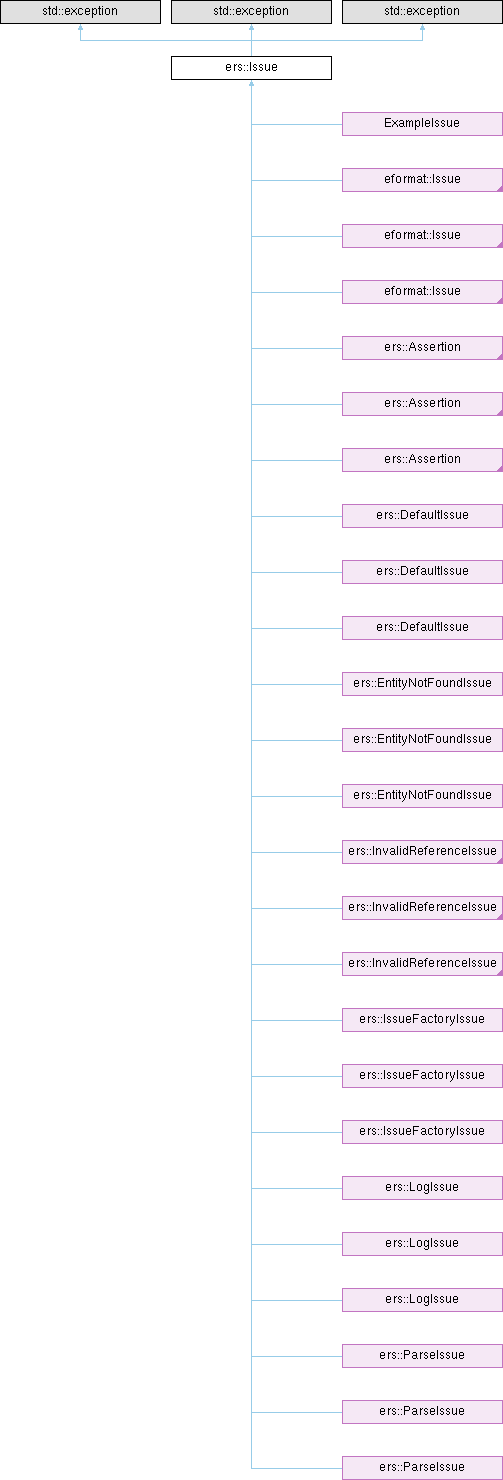
Root Issue class.
This class is the root Issue object. The class does not contain any fields with information, instead everything is stored in a hashmap as key - value paris (both strings). The object contains utility methods to allow the manipulation of those key / values and code to insert common values into it, like time, compilation information, host information etc. For an example of how to build an actual subclass of issue look at the source of ExampleIssue.
- Version
- 1.1
- Note
- Issue chaining is handled by copying the cause issue on the stack and keeping a pointer to it. When the object is destroyed, it destroys the pointed issue. This means we can only chain issues that correctly implement the factory methods required by the IssueFactory class
- See also
- ers::IssueFactory
- ExampleIssue
Definition at line 37 of file Event/ers/include/ers/Issue.h.
Constructor & Destructor Documentation
◆ Issue() [1/18]
|
protected |
Constructor for subclasses.
This is an overloaded member function, provided for convenience. It differs from the above function only in what argument(s) it accepts.
Definition at line 122 of file ers/src/Issue.cxx.
Referenced by ers::Assertion::Assertion(), ers::Assertion::Assertion(), ers::Assertion::Assertion(), cause(), cause(), clone(), ers::DefaultIssue::DefaultIssue(), ers::EntityNotFoundIssue::EntityNotFoundIssue(), ers::EntityNotFoundIssue::EntityNotFoundIssue(), ers::EntityNotFoundIssue::EntityNotFoundIssue(), ExampleIssue::ExampleIssue(), ExampleIssue::ExampleIssue(), ExampleIssue::ExampleIssue(), ers::InvalidReferenceIssue::InvalidReferenceIssue(), ers::InvalidReferenceIssue::InvalidReferenceIssue(), ers::InvalidReferenceIssue::InvalidReferenceIssue(), Issue(), Issue(), Issue(), Issue(), Issue(), Issue(), ers::IssueFactoryIssue::IssueFactoryIssue(), ers::IssueFactoryIssue::IssueFactoryIssue(), ers::IssueFactoryIssue::IssueFactoryIssue(), ers::LogIssue::LogIssue(), ers::LogIssue::LogIssue(), ers::LogIssue::LogIssue(), operator=(), operator==(), ers::ParseIssue::ParseIssue(), ers::ParseIssue::ParseIssue(), ers::ParseIssue::ParseIssue(), ers::ParseIssue::ParseIssue(), qualifiers(), and ~Issue().
◆ Issue() [2/18]
| Issue::Issue | ( | ) |
Empty constructor, should only be used when deserialising issues
Definition at line 79 of file ers/src/Issue.cxx.
◆ Issue() [3/18]
| Issue::Issue | ( | const Issue & | issue | ) |
Copy constructor The m_human_description and the m_value_table fields are simply copied The The issue in the m_cause pointer if present is cloned.
- Parameters
-
issue original for copy
Definition at line 90 of file ers/src/Issue.cxx.
◆ Issue() [4/18]
| Issue::Issue | ( | const string_map_type & | values | ) |
Builds an Issue out of a value table
- Parameters
-
values table of values for the issue
Definition at line 101 of file ers/src/Issue.cxx.
◆ Issue() [5/18]
| Issue::Issue | ( | const Context & | context, |
| severity_t | s, | ||
| const std::string & | m ) |
Constructor
- Parameters
-
context the context of the Issue, e.g where in the code did the issue appear s severity_t of the Issue m message of the Issue
Definition at line 113 of file ers/src/Issue.cxx.
◆ Issue() [6/18]
| Issue::Issue | ( | const Context & | context, |
| severity_t | s, | ||
| const std::exception * | cause_exception ) |
Constructor - takes another exceptions as the cause for the current exception.
- Parameters
-
context the context of the Issue, e.g where in the code did the issue appear s the severity_t of the exception cause_exception the exception that caused the current Issue
Definition at line 134 of file ers/src/Issue.cxx.
◆ ~Issue() [1/3]
|
virtual | ||||||||||||
Destructor. If the m_cause pointer is not null, the pointed Issue is deleted
Reimplemented in eformat::Issue, eformat::Issue, and eformat::Issue.
Definition at line 146 of file ers/src/Issue.cxx.
◆ Issue() [7/18]
|
protected |
Constructor for subclasses.
◆ Issue() [8/18]
| ers::Issue::Issue | ( | ) |
◆ Issue() [9/18]
| ers::Issue::Issue | ( | const Issue & | issue | ) |
◆ Issue() [10/18]
| ers::Issue::Issue | ( | const string_map_type & | values | ) |
◆ Issue() [11/18]
| ers::Issue::Issue | ( | const Context & | context, |
| severity_t | s, | ||
| const std::string & | message ) |
◆ Issue() [12/18]
| ers::Issue::Issue | ( | const Context & | context, |
| severity_t | s, | ||
| const std::exception * | cause ) |
◆ ~Issue() [2/3]
|
virtual | ||||||||||||
Reimplemented in eformat::Issue, eformat::Issue, and eformat::Issue.
◆ Issue() [13/18]
|
protected |
Constructor for subclasses.
◆ Issue() [14/18]
| ers::Issue::Issue | ( | ) |
◆ Issue() [15/18]
| ers::Issue::Issue | ( | const Issue & | issue | ) |
◆ Issue() [16/18]
| ers::Issue::Issue | ( | const string_map_type & | values | ) |
◆ Issue() [17/18]
| ers::Issue::Issue | ( | const Context & | context, |
| severity_t | s, | ||
| const std::string & | message ) |
◆ Issue() [18/18]
| ers::Issue::Issue | ( | const Context & | context, |
| severity_t | s, | ||
| const std::exception * | cause ) |
◆ ~Issue() [3/3]
|
virtual | ||||||||||||
Reimplemented in eformat::Issue, eformat::Issue, and eformat::Issue.
Member Function Documentation
◆ add_qualifier() [1/3]
| void Issue::add_qualifier | ( | const std::string & | qualif | ) |
adds a qualifier to the issue
Add a qualifier to the qualifier list
- Parameters
-
qualif the qualifier to add
Definition at line 680 of file ers/src/Issue.cxx.
Referenced by add_qualifier(), and insert().
◆ add_qualifier() [2/3]
| void ers::Issue::add_qualifier | ( | const std::string & | qualif | ) |
adds a qualifier to the issue
◆ add_qualifier() [3/3]
| void ers::Issue::add_qualifier | ( | const std::string & | qualif | ) |
adds a qualifier to the issue
◆ cause() [1/6]
| const Issue * Issue::cause | ( | ) | const | |||
| throw | ( | ) | ||||
◆ cause() [2/6]
◆ cause() [3/6]
◆ cause() [4/6]
| void Issue::cause | ( | const std::exception * | c = 0 | ) |
Initialises the cause field.
Sets the cause of the issue If the cause is an Issue, it is cloned and stored in the m_cause pointer. In all cases, the description of the cause is stored in the value table using the CAUSE_TEXT_KEY key. If the cause pointer is null, the m_cause field is simply cleared.
- Parameters
-
c pointer to the cause exception
Definition at line 242 of file ers/src/Issue.cxx.
◆ cause() [5/6]
| void ers::Issue::cause | ( | const std::exception * | cause = 0 | ) |
Initialises the cause field.
◆ cause() [6/6]
| void ers::Issue::cause | ( | const std::exception * | cause = 0 | ) |
Initialises the cause field.
◆ clone() [1/3]
| Issue * Issue::clone | ( | ) | const |
Builds a clone of the object. The object is allocated on the stack, and should be deleted by the caller
- Returns
- a new object that is a copy of the current object
Definition at line 159 of file ers/src/Issue.cxx.
Referenced by cause(), clone(), and ers::FIFOStream::send().
◆ clone() [2/3]
| Issue * ers::Issue::clone | ( | ) | const |
◆ clone() [3/3]
| Issue * ers::Issue::clone | ( | ) | const |
◆ exit_value() [1/3]
|
virtual | ||||||||||||
value to pass to exit
Definition at line 670 of file ers/src/Issue.cxx.
Referenced by exit_value().
◆ exit_value() [2/3]
|
virtual | ||||||||||||
value to pass to exit
◆ exit_value() [3/3]
|
virtual | ||||||||||||
value to pass to exit
◆ finish_setup() [1/3]
|
protected | |||||||||||||
Finishes the setup of the Issue.
Finishes the setting up of the information fields. In particular, in fills in the human message and the class type fields (those fields are not available until the end of the object construction.
- Note
- this method should be called by the sub-class constructor, so that RTTI information is setup and correct.
- Parameters
-
message human readable message
- Note
- All method used within this method should throw no exceptions to avoid circular problems.
Definition at line 553 of file ers/src/Issue.cxx.
Referenced by eformat::BadVersionIssue::BadVersionIssue(), ers::EntityNotFoundIssue::EntityNotFoundIssue(), ExampleIssue::ExampleIssue(), finish_setup(), ers::InvalidReferenceIssue::InvalidReferenceIssue(), eformat::Issue::Issue(), Issue(), Issue(), ers::IssueFactoryIssue::IssueFactoryIssue(), ers::LogIssue::LogIssue(), eformat::NoSuchChildIssue::NoSuchChildIssue(), eformat::NotAlignedIssue::NotAlignedIssue(), eformat::OutOfBoundsIssue::OutOfBoundsIssue(), ers::ParseIssue::ParseIssue(), ers::ParseIssue::ParseIssue(), ers::RangeIssue::RangeIssue(), ers::Assertion::setup(), eformat::SizeCheckIssue::SizeCheckIssue(), eformat::TooBigCountIssue::TooBigCountIssue(), eformat::UnboundSourceIdentifierIssue::UnboundSourceIdentifierIssue(), eformat::WrongMarkerIssue::WrongMarkerIssue(), and eformat::WrongSizeIssue::WrongSizeIssue().
◆ finish_setup() [2/3]
|
protected | |||||||||||||
Finishes the setup of the Issue.
◆ finish_setup() [3/3]
|
protected | |||||||||||||
Finishes the setup of the Issue.
◆ get_class_name() [1/3]
|
virtual | ||||||||||||
Get key for class (used for serialisation).
Returns the key used to describe this particular class when serializing This method tries to build a meaningfull class name out of C++ RTTI. This depends on the compiler providing information in a format similar to gcc. For more safety. If the gcc unmangling fails the default (ers::Issue) is used.
Reimplemented in ers::Assertion, ers::Assertion, ers::Assertion, ers::DefaultIssue, ers::DefaultIssue, ers::DefaultIssue, ers::EntityNotFoundIssue, ers::EntityNotFoundIssue, ers::EntityNotFoundIssue, ers::InvalidReferenceIssue, ers::InvalidReferenceIssue, ers::InvalidReferenceIssue, ers::IssueFactoryIssue, ers::IssueFactoryIssue, ers::IssueFactoryIssue, ers::LogIssue, ers::LogIssue, ers::LogIssue, ers::NotImplemented, ers::NotImplemented, ers::NotImplemented, ers::ParseIssue, ers::ParseIssue, ers::ParseIssue, ers::Precondition, ers::Precondition, ers::Precondition, ers::RangeIssue, ers::RangeIssue, ers::RangeIssue, and ExampleIssue.
Definition at line 570 of file ers/src/Issue.cxx.
Referenced by ers::IssueFactory::build(), finish_setup(), and get_class_name().
◆ get_class_name() [2/3]
|
virtual | ||||||||||||
Get key for class (used for serialisation).
Reimplemented in ers::Assertion, ers::Assertion, ers::Assertion, ers::DefaultIssue, ers::DefaultIssue, ers::DefaultIssue, ers::EntityNotFoundIssue, ers::EntityNotFoundIssue, ers::EntityNotFoundIssue, ers::InvalidReferenceIssue, ers::InvalidReferenceIssue, ers::InvalidReferenceIssue, ers::IssueFactoryIssue, ers::IssueFactoryIssue, ers::IssueFactoryIssue, ers::LogIssue, ers::LogIssue, ers::LogIssue, ers::NotImplemented, ers::NotImplemented, ers::NotImplemented, ers::ParseIssue, ers::ParseIssue, ers::ParseIssue, ers::Precondition, ers::Precondition, ers::Precondition, ers::RangeIssue, ers::RangeIssue, ers::RangeIssue, and ExampleIssue.
◆ get_class_name() [3/3]
|
virtual | ||||||||||||
Get key for class (used for serialisation).
Reimplemented in ers::Assertion, ers::Assertion, ers::Assertion, ers::DefaultIssue, ers::DefaultIssue, ers::DefaultIssue, ers::EntityNotFoundIssue, ers::EntityNotFoundIssue, ers::EntityNotFoundIssue, ers::InvalidReferenceIssue, ers::InvalidReferenceIssue, ers::InvalidReferenceIssue, ers::IssueFactoryIssue, ers::IssueFactoryIssue, ers::IssueFactoryIssue, ers::LogIssue, ers::LogIssue, ers::LogIssue, ers::NotImplemented, ers::NotImplemented, ers::NotImplemented, ers::ParseIssue, ers::ParseIssue, ers::ParseIssue, ers::Precondition, ers::Precondition, ers::Precondition, ers::RangeIssue, ers::RangeIssue, ers::RangeIssue, and ExampleIssue.
◆ get_double_value() [1/3]
| double Issue::get_double_value | ( | const std::string | key, | |||
| double | def = nan( "" ) ) const | |||||
| throw | ( | ) | ||||
Get a value of the table as double.
Get a property of an issue as an double
- Parameters
-
key the key to search for def the value to return if key is not found - the default value for this parameter is NaN.
- Returns
- value of key or
def
Definition at line 334 of file ers/src/Issue.cxx.
Referenced by get_double_value().
◆ get_double_value() [2/3]
| double ers::Issue::get_double_value | ( | const std::string | key, | |||
| double | def ) const | |||||
| throw | ( | ) | ||||
Get a value of the table as double.
◆ get_double_value() [3/3]
| double ers::Issue::get_double_value | ( | const std::string | key, | |||
| double | def ) const | |||||
| throw | ( | ) | ||||
Get a value of the table as double.
◆ get_int_value() [1/3]
| int Issue::get_int_value | ( | const std::string & | key, | |||
| int | def = 0 ) const | |||||
| throw | ( | ) | ||||
Get a value of the table as an integer.
Get a property of an issue as an integer
- Parameters
-
key the key to search for def the value to return if key is not found
- Returns
- value of key or
def
Definition at line 290 of file ers/src/Issue.cxx.
Referenced by eformat::SizeCheckIssue::actual(), eformat::TooBigCountIssue::count(), eformat::BadVersionIssue::current(), eformat::WrongMarkerIssue::current(), exit_value(), eformat::WrongMarkerIssue::expected(), get_int_value(), eformat::SizeCheckIssue::informed(), eformat::TooBigCountIssue::max_count(), eformat::OutOfBoundsIssue::pos(), ExampleIssue::procrastination_level(), eformat::NoSuchChildIssue::requested(), eformat::NotAlignedIssue::size(), eformat::OutOfBoundsIssue::size(), eformat::WrongSizeIssue::size(), eformat::UnboundSourceIdentifierIssue::source_id(), eformat::BadVersionIssue::supported(), and eformat::NoSuchChildIssue::total().
◆ get_int_value() [2/3]
| int ers::Issue::get_int_value | ( | const std::string & | key, | |||
| int | def = 0 ) const | |||||
| throw | ( | ) | ||||
Get a value of the table as an integer.
◆ get_int_value() [3/3]
| int ers::Issue::get_int_value | ( | const std::string & | key, | |||
| int | def = 0 ) const | |||||
| throw | ( | ) | ||||
Get a value of the table as an integer.
◆ get_long_value() [1/3]
| long Issue::get_long_value | ( | const std::string & | key, | |||
| long | def = 0 ) const | |||||
| throw | ( | ) | ||||
Get a value of the table as a long integer.
Get a property of an issue as an long
- Parameters
-
key the key to search for def the value to return if key is not found
- Returns
- value of key or
def
Definition at line 312 of file ers/src/Issue.cxx.
Referenced by get_long_value().
◆ get_long_value() [2/3]
| long ers::Issue::get_long_value | ( | const std::string & | key, | |||
| long | def = 0 ) const | |||||
| throw | ( | ) | ||||
Get a value of the table as a long integer.
◆ get_long_value() [3/3]
| long ers::Issue::get_long_value | ( | const std::string & | key, | |||
| long | def = 0 ) const | |||||
| throw | ( | ) | ||||
Get a value of the table as a long integer.
◆ get_value() [1/6]
| const std::string & Issue::get_value | ( | const std::string & | key | ) | const | |
| throw | ( | ) | ||||
This is an overloaded member function, provided for convenience. It differs from the above function only in what argument(s) it accepts.
Definition at line 280 of file ers/src/Issue.cxx.
◆ get_value() [2/6]
| const std::string & ers::Issue::get_value | ( | const std::string & | key | ) | const | |
| throw | ( | ) | ||||
◆ get_value() [3/6]
| const std::string & ers::Issue::get_value | ( | const std::string & | key | ) | const | |
| throw | ( | ) | ||||
◆ get_value() [4/6]
| const std::string & Issue::get_value | ( | const std::string & | key, | |||
| const std::string & | def ) const | |||||
| throw | ( | ) | ||||
Reads the property list.
General method for querying properties of the Issue
- Parameters
-
key the key to lookup
- Returns
- the string value for the key and empty string if the key is not found
Definition at line 270 of file ers/src/Issue.cxx.
Referenced by add_qualifier(), eformat::NotAlignedIssue::base(), get_double_value(), get_int_value(), get_long_value(), get_value(), get_value(), ers::FilterStream::is_accept(), message(), eformat::UnboundSourceIdentifierIssue::my_context(), operator[](), qualifiers(), responsibility(), ers::DefaultStream::send(), ers::HumanStream::send(), severity(), severity_message(), and transience().
◆ get_value() [5/6]
| const std::string & ers::Issue::get_value | ( | const std::string & | key, | |||
| const std::string & | def ) const | |||||
| throw | ( | ) | ||||
Reads the property list.
◆ get_value() [6/6]
| const std::string & ers::Issue::get_value | ( | const std::string & | key, | |||
| const std::string & | def ) const | |||||
| throw | ( | ) | ||||
Reads the property list.
◆ get_value_table() [1/3]
| const string_map_type * Issue::get_value_table | ( | ) | const |
extract value table
Returns a read-only pointer to the value table
- Returns
- read only pointer to the table
Definition at line 261 of file ers/src/Issue.cxx.
Referenced by ers::IssueFactory::build(), get_value_table(), ers::DefaultStream::send(), and ers::HumanStream::send().
◆ get_value_table() [2/3]
| const string_map_type * ers::Issue::get_value_table | ( | ) | const |
extract value table
◆ get_value_table() [3/3]
| const string_map_type * ers::Issue::get_value_table | ( | ) | const |
extract value table
◆ human_description() [1/3]
| const std::string & Issue::human_description | ( | ) | const | |||
| throw | ( | ) | ||||
Human description message.
- Returns
- human description of the Issue
Definition at line 651 of file ers/src/Issue.cxx.
Referenced by human_description(), operator std::string(), ers::operator<<(), and what().
◆ human_description() [2/3]
| const std::string & ers::Issue::human_description | ( | ) | const | |||
| throw | ( | ) | ||||
Human description message.
◆ human_description() [3/3]
| const std::string & ers::Issue::human_description | ( | ) | const | |||
| throw | ( | ) | ||||
Human description message.
◆ insert() [1/3]
|
protected | |||||||||||||
Inserts the context.
Inserts the context of the issue into the issue
- Parameters
-
context pointer to context object
Definition at line 469 of file ers/src/Issue.cxx.
Referenced by setup_common().
◆ insert() [2/3]
|
protected | |||||||||||||
Inserts the context.
◆ insert() [3/3]
|
protected | |||||||||||||
Inserts the context.
◆ insert_time() [1/3]
|
protected | ||||||||||||
Inserts current time.
Inserts the current time into the issue
Definition at line 496 of file ers/src/Issue.cxx.
Referenced by setup_common().
◆ insert_time() [2/3]
|
protected | ||||||||||||
Inserts current time.
◆ insert_time() [3/3]
|
protected | ||||||||||||
Inserts current time.
◆ is_error() [1/3]
| bool Issue::is_error | ( | ) |
is the issue an error (or fatal).
Is the issue either an error or a fatal error
- Returns
trueif the issue is either an error or a fatal
Definition at line 601 of file ers/src/Issue.cxx.
Referenced by ers::StreamFactory::dispatch(), and is_error().
◆ is_error() [2/3]
| bool ers::Issue::is_error | ( | ) |
is the issue an error (or fatal).
◆ is_error() [3/3]
| bool ers::Issue::is_error | ( | ) |
is the issue an error (or fatal).
◆ message() [1/3]
| const std::string & Issue::message | ( | ) | const | |||
| throw | ( | ) | ||||
Message.
Definition at line 666 of file ers/src/Issue.cxx.
Referenced by ers::Assertion::Assertion(), ers::NotImplemented::build_message(), ers::Precondition::build_message(), ers::InvalidReferenceIssue::check_reference(), finish_setup(), ers::InvalidReferenceIssue::InvalidReferenceIssue(), Issue(), ers::IssueFactoryIssue::IssueFactoryIssue(), ers::LogIssue::LogIssue(), message(), ers::ParseIssue::ParseIssue(), ers::ParseIssue::ParseIssue(), ers::Precondition::Precondition(), and ers::Assertion::setup().
◆ message() [2/3]
| const std::string & ers::Issue::message | ( | ) | const | |||
| throw | ( | ) | ||||
Message.
◆ message() [3/3]
| const std::string & ers::Issue::message | ( | ) | const | |||
| throw | ( | ) | ||||
Message.
◆ operator std::string() [1/3]
| Issue::operator std::string | ( | ) | const |
Converts the issue into a string.
Definition at line 161 of file ers/src/Issue.cxx.
◆ operator std::string() [2/3]
| ers::Issue::operator std::string | ( | ) | const |
Converts the issue into a string.
◆ operator std::string() [3/3]
| ers::Issue::operator std::string | ( | ) | const |
Converts the issue into a string.
◆ operator=() [1/3]
Affectation operator.
Copy operator
- Parameters
-
source the original issue
- Returns
- the copy issue
- Note
- The
m_causemember, if non null, is cloned
Definition at line 172 of file ers/src/Issue.cxx.
◆ operator=() [2/3]
◆ operator=() [3/3]
◆ operator==() [1/3]
| bool Issue::operator== | ( | const Issue & | other | ) | const | |
| throw | ( | ) | ||||
Equality operator.
Comparison operator
- Parameters
-
other issue to compare to
- Returns
trueifthisandotherare equal
Definition at line 182 of file ers/src/Issue.cxx.
◆ operator==() [2/3]
| bool ers::Issue::operator== | ( | const Issue & | other | ) | const | |
| throw | ( | ) | ||||
Equality operator.
◆ operator==() [3/3]
| bool ers::Issue::operator== | ( | const Issue & | other | ) | const | |
| throw | ( | ) | ||||
Equality operator.
◆ operator[]() [1/3]
| const std::string & Issue::operator[] | ( | const std::string & | key | ) | const | |
| throw | ( | ) | ||||
Array access operator
- Parameters
-
key the resolve
- Returns
- string containing value
- See also
- get_value(const std::string &)
Definition at line 194 of file ers/src/Issue.cxx.
◆ operator[]() [2/3]
| const std::string & ers::Issue::operator[] | ( | const std::string & | key | ) | const | |
| throw | ( | ) | ||||
◆ operator[]() [3/3]
| const std::string & ers::Issue::operator[] | ( | const std::string & | key | ) | const | |
| throw | ( | ) | ||||
◆ qualifiers() [1/3]
| std::vector< std::string > Issue::qualifiers | ( | ) | const |
return array of qualifiers
Gets the list of qualifiers
- Returns
- list of qualifiers
Definition at line 692 of file ers/src/Issue.cxx.
Referenced by qualifiers().
◆ qualifiers() [2/3]
| std::vector< std::string > ers::Issue::qualifiers | ( | ) | const |
return array of qualifiers
◆ qualifiers() [3/3]
| std::vector< std::string > ers::Issue::qualifiers | ( | ) | const |
return array of qualifiers
◆ responsibility() [1/6]
| responsibility_t Issue::responsibility | ( | ) | const | |||
| throw | ( | ) | ||||
get the responsability level of the issue
Gets the responsibility type of the Issue
- Returns
- the responsibiliy value of the Issue
Definition at line 618 of file ers/src/Issue.cxx.
Referenced by ers::InvalidReferenceIssue::InvalidReferenceIssue().
◆ responsibility() [2/6]
| responsibility_t ers::Issue::responsibility | ( | ) | const | |||
| throw | ( | ) | ||||
get the responsability level of the issue
◆ responsibility() [3/6]
| responsibility_t ers::Issue::responsibility | ( | ) | const | |||
| throw | ( | ) | ||||
get the responsability level of the issue
◆ responsibility() [4/6]
| void Issue::responsibility | ( | responsibility_t | r | ) |
set the responsability of the issue
Sets the responsbility of the Issue
- Parameters
-
r the responsibility type
Definition at line 627 of file ers/src/Issue.cxx.
Referenced by responsibility(), responsibility(), and ers::Assertion::setup().
◆ responsibility() [5/6]
| void ers::Issue::responsibility | ( | responsibility_t | r | ) |
set the responsability of the issue
◆ responsibility() [6/6]
| void ers::Issue::responsibility | ( | responsibility_t | r | ) |
set the responsability of the issue
◆ set_value() [1/36]
| void Issue::set_value | ( | const std::string & | key, | |||
| const char * | value ) | |||||
| throw | ( | ) | ||||
Sets a value (c-string).
Sets a string value in the value table
- Parameters
-
key the key to use for insertion value c-string, null pointer is ignored.
Definition at line 434 of file ers/src/Issue.cxx.
◆ set_value() [2/36]
| void ers::Issue::set_value | ( | const std::string & | key, | |||
| const char * | value ) | |||||
| throw | ( | ) | ||||
Sets a value (c-string).
◆ set_value() [3/36]
| void ers::Issue::set_value | ( | const std::string & | key, | |||
| const char * | value ) | |||||
| throw | ( | ) | ||||
Sets a value (c-string).
◆ set_value() [4/36]
| void Issue::set_value | ( | const std::string & | key, | |||
| const std::string & | value ) | |||||
| throw | ( | ) | ||||
Sets a value (string).
Sets a string value in the value table
- Parameters
-
key the key to use for insertion value the value to insert
Definition at line 425 of file ers/src/Issue.cxx.
◆ set_value() [5/36]
| void ers::Issue::set_value | ( | const std::string & | key, | |||
| const std::string & | value ) | |||||
| throw | ( | ) | ||||
Sets a value (string).
◆ set_value() [6/36]
| void ers::Issue::set_value | ( | const std::string & | key, | |||
| const std::string & | value ) | |||||
| throw | ( | ) | ||||
Sets a value (string).
◆ set_value() [7/36]
| void Issue::set_value | ( | const std::string & | key, | |||
| const void * | ptr ) | |||||
| throw | ( | ) | ||||
Sets a pointer in the value table
- Parameters
-
key the key to use for insertion ptr a pointer
- Note
- the pointer is stored in hex format
Definition at line 448 of file ers/src/Issue.cxx.
◆ set_value() [8/36]
| void ers::Issue::set_value | ( | const std::string & | key, | |||
| const void * | ptr ) | |||||
| throw | ( | ) | ||||
◆ set_value() [9/36]
| void ers::Issue::set_value | ( | const std::string & | key, | |||
| const void * | ptr ) | |||||
| throw | ( | ) | ||||
◆ set_value() [10/36]
| void Issue::set_value | ( | const std::string & | key, | |||
| double | value ) | |||||
| throw | ( | ) | ||||
Sets a value (double float).
Set a numerical value in the value table
- Parameters
-
key the key to use for insertion value the value to insert
Definition at line 414 of file ers/src/Issue.cxx.
◆ set_value() [11/36]
| void ers::Issue::set_value | ( | const std::string & | key, | |||
| double | value ) | |||||
| throw | ( | ) | ||||
Sets a value (double float).
◆ set_value() [12/36]
| void ers::Issue::set_value | ( | const std::string & | key, | |||
| double | value ) | |||||
| throw | ( | ) | ||||
Sets a value (double float).
◆ set_value() [13/36]
| void Issue::set_value | ( | const std::string & | key, | |||
| int16_t | value ) | |||||
| throw | ( | ) | ||||
This is an overloaded member function, provided for convenience. It differs from the above function only in what argument(s) it accepts.
Definition at line 393 of file ers/src/Issue.cxx.
◆ set_value() [14/36]
| void ers::Issue::set_value | ( | const std::string & | key, | |||
| int16_t | value ) | |||||
| throw | ( | ) | ||||
◆ set_value() [15/36]
| void ers::Issue::set_value | ( | const std::string & | key, | |||
| int16_t | value ) | |||||
| throw | ( | ) | ||||
◆ set_value() [16/36]
| void Issue::set_value | ( | const std::string & | key, | |||
| int32_t | value ) | |||||
| throw | ( | ) | ||||
This is an overloaded member function, provided for convenience. It differs from the above function only in what argument(s) it accepts.
Definition at line 399 of file ers/src/Issue.cxx.
◆ set_value() [17/36]
| void ers::Issue::set_value | ( | const std::string & | key, | |||
| int32_t | value ) | |||||
| throw | ( | ) | ||||
◆ set_value() [18/36]
| void ers::Issue::set_value | ( | const std::string & | key, | |||
| int32_t | value ) | |||||
| throw | ( | ) | ||||
◆ set_value() [19/36]
| void Issue::set_value | ( | const std::string & | key, | |||
| int64_t | value ) | |||||
| throw | ( | ) | ||||
This is an overloaded member function, provided for convenience. It differs from the above function only in what argument(s) it accepts.
Definition at line 405 of file ers/src/Issue.cxx.
◆ set_value() [20/36]
| void ers::Issue::set_value | ( | const std::string & | key, | |||
| int64_t | value ) | |||||
| throw | ( | ) | ||||
◆ set_value() [21/36]
| void ers::Issue::set_value | ( | const std::string & | key, | |||
| int64_t | value ) | |||||
| throw | ( | ) | ||||
◆ set_value() [22/36]
| void Issue::set_value | ( | const std::string & | key, | |||
| int8_t | value ) | |||||
| throw | ( | ) | ||||
This is an overloaded member function, provided for convenience. It differs from the above function only in what argument(s) it accepts.
Definition at line 387 of file ers/src/Issue.cxx.
◆ set_value() [23/36]
| void ers::Issue::set_value | ( | const std::string & | key, | |||
| int8_t | value ) | |||||
| throw | ( | ) | ||||
◆ set_value() [24/36]
| void ers::Issue::set_value | ( | const std::string & | key, | |||
| int8_t | value ) | |||||
| throw | ( | ) | ||||
◆ set_value() [25/36]
| void Issue::set_value | ( | const std::string & | key, | |||
| uint16_t | value ) | |||||
| throw | ( | ) | ||||
This is an overloaded member function, provided for convenience. It differs from the above function only in what argument(s) it accepts.
Definition at line 369 of file ers/src/Issue.cxx.
◆ set_value() [26/36]
| void ers::Issue::set_value | ( | const std::string & | key, | |||
| uint16_t | value ) | |||||
| throw | ( | ) | ||||
◆ set_value() [27/36]
| void ers::Issue::set_value | ( | const std::string & | key, | |||
| uint16_t | value ) | |||||
| throw | ( | ) | ||||
◆ set_value() [28/36]
| void Issue::set_value | ( | const std::string & | key, | |||
| uint32_t | value ) | |||||
| throw | ( | ) | ||||
This is an overloaded member function, provided for convenience. It differs from the above function only in what argument(s) it accepts.
Definition at line 375 of file ers/src/Issue.cxx.
◆ set_value() [29/36]
| void ers::Issue::set_value | ( | const std::string & | key, | |||
| uint32_t | value ) | |||||
| throw | ( | ) | ||||
◆ set_value() [30/36]
| void ers::Issue::set_value | ( | const std::string & | key, | |||
| uint32_t | value ) | |||||
| throw | ( | ) | ||||
◆ set_value() [31/36]
| void Issue::set_value | ( | const std::string & | key, | |||
| uint64_t | value ) | |||||
| throw | ( | ) | ||||
This is an overloaded member function, provided for convenience. It differs from the above function only in what argument(s) it accepts.
Definition at line 381 of file ers/src/Issue.cxx.
◆ set_value() [32/36]
| void ers::Issue::set_value | ( | const std::string & | key, | |||
| uint64_t | value ) | |||||
| throw | ( | ) | ||||
◆ set_value() [33/36]
| void ers::Issue::set_value | ( | const std::string & | key, | |||
| uint64_t | value ) | |||||
| throw | ( | ) | ||||
◆ set_value() [34/36]
| void Issue::set_value | ( | const std::string & | key, | |||
| uint8_t | value ) | |||||
| throw | ( | ) | ||||
Sets a value 8 bit unsigned.
Set a numerical value in the value table
- Parameters
-
key the key to use for insertion value the value to insert
Definition at line 363 of file ers/src/Issue.cxx.
Referenced by add_qualifier(), eformat::BadVersionIssue::BadVersionIssue(), cause(), ers::EntityNotFoundIssue::EntityNotFoundIssue(), ExampleIssue::ExampleIssue(), finish_setup(), insert(), insert_time(), eformat::NoSuchChildIssue::NoSuchChildIssue(), eformat::NotAlignedIssue::NotAlignedIssue(), ers::ParseIssue::offending_line_number(), eformat::OutOfBoundsIssue::OutOfBoundsIssue(), ers::InvalidReferenceIssue::pointer(), ers::RangeIssue::RangeIssue(), responsibility(), ers::RangeIssue::set_range(), set_value(), set_value(), set_value(), set_value(), set_value(), set_value(), set_value(), set_value(), set_value(), set_value(), set_value(), set_value(), ers::Assertion::setup(), severity(), eformat::SizeCheckIssue::SizeCheckIssue(), eformat::TooBigCountIssue::TooBigCountIssue(), transience(), eformat::UnboundSourceIdentifierIssue::UnboundSourceIdentifierIssue(), eformat::WrongMarkerIssue::WrongMarkerIssue(), and eformat::WrongSizeIssue::WrongSizeIssue().
◆ set_value() [35/36]
| void ers::Issue::set_value | ( | const std::string & | key, | |||
| uint8_t | value ) | |||||
| throw | ( | ) | ||||
Sets a value 8 bit unsigned.
◆ set_value() [36/36]
| void ers::Issue::set_value | ( | const std::string & | key, | |||
| uint8_t | value ) | |||||
| throw | ( | ) | ||||
Sets a value 8 bit unsigned.
◆ set_values() [1/3]
|
protected | |||||||||||||
sets the value table
Sets the value table
- Parameters
-
values the value table to load
Definition at line 354 of file ers/src/Issue.cxx.
Referenced by ers::IssueFactory::build(), Issue(), and set_values().
◆ set_values() [2/3]
|
protected | |||||||||||||
sets the value table
◆ set_values() [3/3]
|
protected | |||||||||||||
sets the value table
◆ setup_common() [1/3]
|
protected | |||||||||||||
Sets up the common fields.
This method sets up common fields for all Issues. In particular, it inserts all data concerning the Issue's context, this includes
- Source code position (file/line)
- Compiler version
- Compilation time and date
- Parameters
-
context context where the exception occured, this should be the ERS_HERE macro.
- Note
- All method used within this method should throw no exceptions to avoid circular problems.
Definition at line 521 of file ers/src/Issue.cxx.
Referenced by Issue(), Issue(), Issue(), and setup_common().
◆ setup_common() [2/3]
|
protected | |||||||||||||
Sets up the common fields.
◆ setup_common() [3/3]
|
protected | |||||||||||||
Sets up the common fields.
◆ severity() [1/6]
| severity_t Issue::severity | ( | ) | const | |||
| throw | ( | ) | ||||
severity_t of the issue
Gets the severity_t of the Issue
- Returns
- severity_t of the Issue
Definition at line 584 of file ers/src/Issue.cxx.
Referenced by eformat::BadVersionIssue::BadVersionIssue(), ers::StreamFactory::debug(), ers::StreamFactory::dispatch(), ers::StreamFactory::error(), ExampleIssue::ExampleIssue(), ExampleIssue::ExampleIssue(), ers::StreamFactory::fatal(), ers::InvalidReferenceIssue::InvalidReferenceIssue(), is_error(), eformat::Issue::Issue(), Issue(), Issue(), Issue(), eformat::NoSuchChildIssue::NoSuchChildIssue(), eformat::NotAlignedIssue::NotAlignedIssue(), eformat::OutOfBoundsIssue::OutOfBoundsIssue(), ers::DefaultStream::send(), severity(), severity(), eformat::SizeCheckIssue::SizeCheckIssue(), eformat::TooBigCountIssue::TooBigCountIssue(), eformat::UnboundSourceIdentifierIssue::UnboundSourceIdentifierIssue(), ers::StreamFactory::warning(), eformat::WrongMarkerIssue::WrongMarkerIssue(), and eformat::WrongSizeIssue::WrongSizeIssue().
◆ severity() [2/6]
| severity_t ers::Issue::severity | ( | ) | const | |||
| throw | ( | ) | ||||
severity_t of the issue
◆ severity() [3/6]
| severity_t ers::Issue::severity | ( | ) | const | |||
| throw | ( | ) | ||||
severity_t of the issue
◆ severity() [4/6]
| void Issue::severity | ( | severity_t | s | ) |
sets the severity_t of the issue
Set the severity_t of the Issue
- Parameters
-
s the severity_t level
Definition at line 593 of file ers/src/Issue.cxx.
◆ severity() [5/6]
| void ers::Issue::severity | ( | severity_t | s | ) |
sets the severity_t of the issue
◆ severity() [6/6]
| void ers::Issue::severity | ( | severity_t | s | ) |
sets the severity_t of the issue
◆ severity_message() [1/3]
| std::string Issue::severity_message | ( | ) | const |
message associated with the severity_t of the issue
- Returns
- the string representing the severity_t of the issue
Definition at line 610 of file ers/src/Issue.cxx.
Referenced by severity_message().
◆ severity_message() [2/3]
| std::string ers::Issue::severity_message | ( | ) | const |
message associated with the severity_t of the issue
◆ severity_message() [3/3]
| std::string ers::Issue::severity_message | ( | ) | const |
message associated with the severity_t of the issue
◆ transience() [1/6]
| int Issue::transience | ( | ) | const | |||
| throw | ( | ) | ||||
is the issue transient
- Returns
- the transience of the issue, 1 = true, 0 = false, -1 = unknown
Definition at line 642 of file ers/src/Issue.cxx.
Referenced by exit_value().
◆ transience() [2/6]
| int ers::Issue::transience | ( | ) | const | |||
| throw | ( | ) | ||||
is the issue transient
◆ transience() [3/6]
| int ers::Issue::transience | ( | ) | const | |||
| throw | ( | ) | ||||
is the issue transient
◆ transience() [4/6]
| void Issue::transience | ( | bool | tr | ) |
sets if the issue is transient
Sets the transience of the issue
- Parameters
-
tr true if the issue is transient, false if not
Definition at line 635 of file ers/src/Issue.cxx.
Referenced by ers::Assertion::setup(), transience(), and transience().
◆ transience() [5/6]
| void ers::Issue::transience | ( | bool | tr | ) |
sets if the issue is transient
◆ transience() [6/6]
| void ers::Issue::transience | ( | bool | tr | ) |
sets if the issue is transient
◆ values_number() [1/3]
| int Issue::values_number | ( | ) | const |
How many key / values.
- Returns
- the number of key/value pairs in the issue
Definition at line 459 of file ers/src/Issue.cxx.
Referenced by values_number().
◆ values_number() [2/3]
| int ers::Issue::values_number | ( | ) | const |
How many key / values.
◆ values_number() [3/3]
| int ers::Issue::values_number | ( | ) | const |
How many key / values.
◆ what() [1/3]
| const char * Issue::what | ( | ) | const | |||
| throw | ( | ) | ||||
Human description message.
This method overides the what method of the std::exception class. As this method is declared const, it has to use a pre-calculated string
- Returns
- C style string of human_description
Definition at line 661 of file ers/src/Issue.cxx.
Referenced by EFEventLoopMgr::executeEvent(), main(), main(), and what().
◆ what() [2/3]
| const char * ers::Issue::what | ( | ) | const | |||
| throw | ( | ) | ||||
Human description message.
◆ what() [3/3]
| const char * ers::Issue::what | ( | ) | const | |||
| throw | ( | ) | ||||
Human description message.
Friends And Related Symbol Documentation
◆ IssueFactory
|
friend |
Definition at line 39 of file Event/ers/include/ers/Issue.h.
Referenced by IssueFactory.
◆ Stream
|
friend |
Definition at line 38 of file Event/ers/include/ers/Issue.h.
Referenced by qualifiers(), and Stream.
Member Data Documentation
◆ CAUSE_PSEUDO_KEY
|
static |
key used when serializing the cause issue, this key is not used in the value table
Definition at line 72 of file Event/ers/include/ers/Issue.h.
◆ CAUSE_TEXT_KEY
|
static |
key used to store the cause issue's message
Definition at line 75 of file Event/ers/include/ers/Issue.h.
Referenced by cause().
◆ CLASS_KEY
|
static |
key for class information
Definition at line 42 of file Event/ers/include/ers/Issue.h.
Referenced by finish_setup().
◆ COMPILATION_DEBUG_LVL_KEY
|
static |
Definition at line 46 of file Event/ers/include/ers/Issue.h.
Referenced by insert().
◆ COMPILATION_TARGET_KEY
|
static |
key for compilation target
Definition at line 44 of file Event/ers/include/ers/Issue.h.
Referenced by insert().
◆ COMPILATION_TIME_KEY
|
static |
key for compilation time
Definition at line 43 of file Event/ers/include/ers/Issue.h.
Referenced by insert().
◆ COMPILER_KEY
|
static |
key for compilator type
Definition at line 45 of file Event/ers/include/ers/Issue.h.
Referenced by insert().
◆ CPP_CLASS_KEY
|
static |
key for c++ class (might be mangled)
Definition at line 47 of file Event/ers/include/ers/Issue.h.
◆ ERS_VERSION_KEY
|
static |
key for ERS version
Definition at line 48 of file Event/ers/include/ers/Issue.h.
◆ EXIT_VALUE_KEY
|
static |
key used to store the exit value
Definition at line 79 of file Event/ers/include/ers/Issue.h.
Referenced by exit_value(), and ers::Assertion::setup().
◆ HOST_IP_ADDR_KEY
|
static |
key for host ip address
Definition at line 52 of file Event/ers/include/ers/Issue.h.
◆ HOST_NAME_KEY
|
static |
key for hostname
Definition at line 49 of file Event/ers/include/ers/Issue.h.
◆ HOST_TYPE_KEY
|
static |
key for host type (architecture / os)
Definition at line 50 of file Event/ers/include/ers/Issue.h.
◆ ISSUE_CLASS_NAME
|
static |
name of the class, used for serialisation
Definition at line 80 of file Event/ers/include/ers/Issue.h.
◆ m_cause
|
protected |
Issue that caused the current issue.
Definition at line 84 of file Event/ers/include/ers/Issue.h.
Referenced by cause(), cause(), Issue(), Issue(), operator==(), and ~Issue().
◆ m_class_name
|
mutableprotected |
class name
Definition at line 85 of file Event/ers/include/ers/Issue.h.
Referenced by ers::DefaultIssue::DefaultIssue(), ers::DefaultIssue::get_class_name(), and get_class_name().
◆ m_human_description
|
mutableprotected |
Human readable description (cache).
Definition at line 86 of file Event/ers/include/ers/Issue.h.
Referenced by human_description(), Issue(), Issue(), and Issue().
◆ m_value_table
|
protected |
Optional properties.
Definition at line 87 of file Event/ers/include/ers/Issue.h.
Referenced by ers::InvalidReferenceIssue::check_reference(), ers::ParseIssue::file_name(), get_value(), get_value_table(), Issue(), ers::ParseIssue::offending_line(), operator==(), set_value(), set_value(), set_value(), set_value(), set_value(), set_value(), set_value(), set_value(), set_value(), set_value(), set_value(), set_values(), ers::Assertion::setup(), and values_number().
◆ MESSAGE_KEY
|
static |
key for human readable
Definition at line 53 of file Event/ers/include/ers/Issue.h.
Referenced by finish_setup(), message(), ers::DefaultStream::send(), and ers::HumanStream::send().
◆ PROCESS_ID_KEY
|
static |
key for the process id (number)
Definition at line 54 of file Event/ers/include/ers/Issue.h.
◆ PROCESS_PWD_KEY
|
static |
key for the process working directory
Definition at line 55 of file Event/ers/include/ers/Issue.h.
◆ PROGRAM_NAME_KEY
|
static |
key for the name of the program
Definition at line 57 of file Event/ers/include/ers/Issue.h.
◆ QUALIFIER_LIST_KEY
|
static |
key used to store the qualifier list
Ê
Definition at line 77 of file Event/ers/include/ers/Issue.h.
Referenced by add_qualifier(), ers::FilterStream::is_accept(), and qualifiers().
◆ RESPONSIBILITY_KEY
|
static |
key for the responsibility of the issue (text)
Definition at line 58 of file Event/ers/include/ers/Issue.h.
Referenced by responsibility(), and responsibility().
◆ SEVERITY_KEY
|
static |
key for the severity_t of the issue
Definition at line 60 of file Event/ers/include/ers/Issue.h.
Referenced by ers::DefaultStream::send(), ers::HumanStream::send(), severity(), severity(), and severity_message().
◆ SOURCE_PACKAGE_KEY
|
static |
package name associated with source code
Definition at line 63 of file Event/ers/include/ers/Issue.h.
Referenced by insert().
◆ SOURCE_POSITION_KEY
|
static |
key for position in the source code
Definition at line 61 of file Event/ers/include/ers/Issue.h.
Referenced by insert(), and ers::DefaultStream::send().
◆ TIME_KEY
|
static |
key for the time of the issue (text)
Definition at line 65 of file Event/ers/include/ers/Issue.h.
Referenced by insert_time(), and ers::DefaultStream::send().
◆ TRANSIENCE_KEY
|
static |
key for the transience of the issue (text)
Definition at line 66 of file Event/ers/include/ers/Issue.h.
Referenced by transience(), and transience().
◆ USER_ID_KEY
|
static |
key for the user-id of the owner of the process
Definition at line 68 of file Event/ers/include/ers/Issue.h.
◆ USER_NAME_KEY
|
static |
key for the user-name of the owner of the process
Definition at line 70 of file Event/ers/include/ers/Issue.h.
The documentation for this class was generated from the following files: