#include <Header.h>
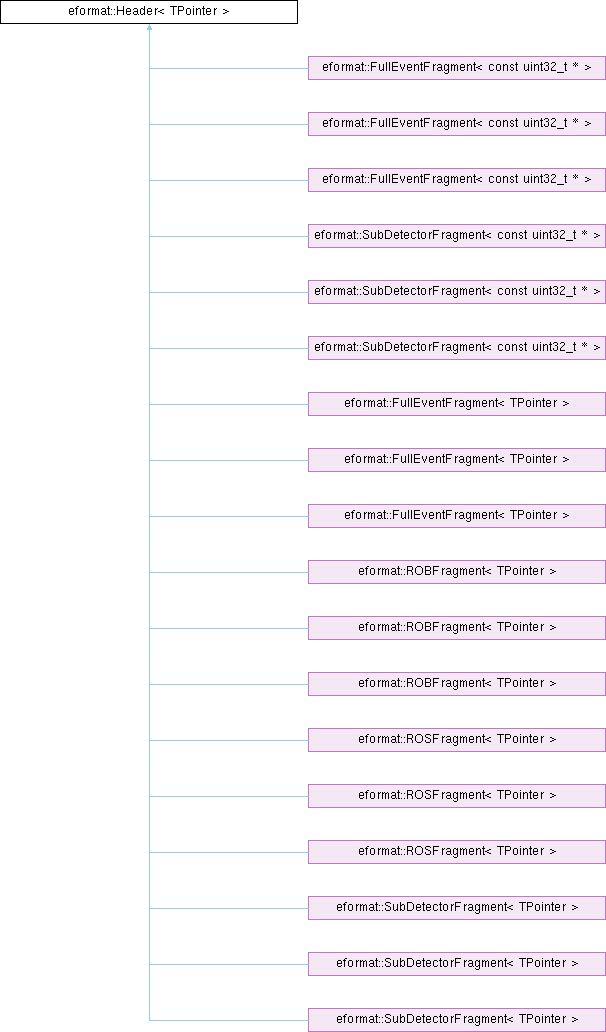
Public Member Functions | |
| Header (const TPointer &it, uint32_t match) | |
| Header () | |
| Header (const Header &other) | |
| virtual | ~Header () |
| Header & | operator= (const Header &other) |
| Header & | assign (const TPointer &it, uint32_t match) |
| virtual bool | check () const |
| uint32_t | marker () const |
| uint32_t | fragment_size_word () const |
| uint32_t | header_size_word () const |
| uint32_t | version () const |
| uint32_t | source_id () const |
| uint32_t | nstatus () const |
| void | start (TPointer &it) const |
| void | payload (TPointer &it) const |
| void | end (TPointer &it) const |
| uint32_t | payload_size_word (void) const |
| void | status (TPointer &it) const |
| uint32_t | nspecific () const |
| void | specific_header (TPointer &it) const |
| virtual uint32_t | nchildren () const |
| virtual void | child (TPointer &p, size_t n) const |
| virtual void | child_check (TPointer &p, size_t n) const |
| virtual uint32_t | children (TPointer *p, size_t max) const |
| Header (const TPointer &it, uint32_t match) | |
| Header () | |
| Header (const Header &other) | |
| virtual | ~Header () |
| Header & | operator= (const Header &other) |
| Header & | assign (const TPointer &it, uint32_t match) |
| virtual bool | check () const |
| uint32_t | marker () const |
| uint32_t | fragment_size_word () const |
| uint32_t | header_size_word () const |
| uint32_t | version () const |
| uint32_t | source_id () const |
| uint32_t | nstatus () const |
| void | start (TPointer &it) const |
| void | payload (TPointer &it) const |
| void | end (TPointer &it) const |
| uint32_t | payload_size_word (void) const |
| void | status (TPointer &it) const |
| uint32_t | nspecific () const |
| void | specific_header (TPointer &it) const |
| virtual uint32_t | nchildren () const |
| virtual void | child (TPointer &p, size_t n) const |
| virtual void | child_check (TPointer &p, size_t n) const |
| virtual uint32_t | children (TPointer *p, size_t max) const |
| Header (const TPointer &it, uint32_t match) | |
| Header () | |
| Header (const Header &other) | |
| virtual | ~Header () |
| Header & | operator= (const Header &other) |
| Header & | assign (const TPointer &it, uint32_t match) |
| virtual bool | check () const |
| uint32_t | marker () const |
| uint32_t | fragment_size_word () const |
| uint32_t | header_size_word () const |
| uint32_t | version () const |
| uint32_t | source_id () const |
| uint32_t | nstatus () const |
| void | start (TPointer &it) const |
| void | payload (TPointer &it) const |
| void | end (TPointer &it) const |
| uint32_t | payload_size_word (void) const |
| void | status (TPointer &it) const |
| uint32_t | nspecific () const |
| void | specific_header (TPointer &it) const |
| virtual uint32_t | nchildren () const |
| virtual void | child (TPointer &p, size_t n) const |
| virtual void | child_check (TPointer &p, size_t n) const |
| virtual uint32_t | children (TPointer *p, size_t max) const |
Detailed Description
class eformat::Header< TPointer >
Contains the information on the Header of a fragment as described by the original note. The header is a composite entity, build from two parts:
- The generic part, containing the header type, size and version information;
- The specific part, containing data that is specific for a particular fragment.
Definition at line 40 of file Event/eformat/include/eformat/Header.h.
Constructor & Destructor Documentation
◆ Header() [1/9]
| eformat::Header< TPointer >::Header | ( | const TPointer & | it, |
| uint32_t | match ) |
To build a header given the containing buffer. I need to know where the header starts in order to do that.
- Parameters
-
it The exact position where this header should start. match The word that this header should match.
Definition at line 232 of file Event/eformat/include/eformat/Header.h.
Referenced by assign(), eformat::FullEventFragment< TPointer >::FullEventFragment(), eformat::FullEventFragment< const uint32_t * >::FullEventFragment(), eformat::FullEventFragment< const uint32_t * >::FullEventFragment(), Header(), operator=(), eformat::ROBFragment< TPointer >::ROBFragment(), eformat::ROBFragment< TPointer >::ROBFragment(), eformat::ROBFragment< TPointer >::ROBFragment(), eformat::ROSFragment< TPointer >::ROSFragment(), eformat::ROSFragment< TPointer >::ROSFragment(), eformat::ROSFragment< TPointer >::ROSFragment(), eformat::SubDetectorFragment< TPointer >::SubDetectorFragment(), eformat::SubDetectorFragment< const uint32_t * >::SubDetectorFragment(), and eformat::SubDetectorFragment< const uint32_t * >::SubDetectorFragment().
◆ Header() [2/9]
|
inline |
Builds an empty, otherwise useless Header
Definition at line 55 of file Event/eformat/include/eformat/Header.h.
◆ Header() [3/9]
|
inline |
Copy constructor
- Parameters
-
other The other header to construct from
Definition at line 62 of file Event/eformat/include/eformat/Header.h.
◆ ~Header() [1/3]
|
inlinevirtual |
Destructor virtualisation
Definition at line 67 of file Event/eformat/include/eformat/Header.h.
◆ Header() [4/9]
| eformat::Header< TPointer >::Header | ( | const TPointer & | it, |
| uint32_t | match ) |
To build a header given the containing buffer. I need to know where the header starts in order to do that.
- Parameters
-
it The exact position where this header should start. match The word that this header should match.
◆ Header() [5/9]
|
inline |
Builds an empty, otherwise useless Header
Definition at line 55 of file InstallArea/x86_64-el9-gcc13-dbg/include/eformat/Header.h.
◆ Header() [6/9]
|
inline |
Copy constructor
- Parameters
-
other The other header to construct from
Definition at line 62 of file InstallArea/x86_64-el9-gcc13-dbg/include/eformat/Header.h.
◆ ~Header() [2/3]
|
inlinevirtual |
Destructor virtualisation
Definition at line 67 of file InstallArea/x86_64-el9-gcc13-dbg/include/eformat/Header.h.
◆ Header() [7/9]
| eformat::Header< TPointer >::Header | ( | const TPointer & | it, |
| uint32_t | match ) |
To build a header given the containing buffer. I need to know where the header starts in order to do that.
- Parameters
-
it The exact position where this header should start. match The word that this header should match.
◆ Header() [8/9]
|
inline |
Builds an empty, otherwise useless Header
Definition at line 55 of file InstallArea/x86_64-el9-gcc13-opt/include/eformat/Header.h.
◆ Header() [9/9]
|
inline |
Copy constructor
- Parameters
-
other The other header to construct from
Definition at line 62 of file InstallArea/x86_64-el9-gcc13-opt/include/eformat/Header.h.
◆ ~Header() [3/3]
|
inlinevirtual |
Destructor virtualisation
Definition at line 67 of file InstallArea/x86_64-el9-gcc13-opt/include/eformat/Header.h.
Member Function Documentation
◆ assign() [1/3]
| eformat::Header< TPointer > & eformat::Header< TPointer >::assign | ( | const TPointer & | it, |
| uint32_t | match ) |
Reassign this header
- Parameters
-
it The exact position where this header should start. match The word that this header should match.
Definition at line 240 of file Event/eformat/include/eformat/Header.h.
Referenced by eformat::FullEventFragment< TPointer >::assign(), eformat::ROBFragment< TPointer >::assign(), eformat::ROSFragment< TPointer >::assign(), and eformat::SubDetectorFragment< TPointer >::assign().
◆ assign() [2/3]
| Header & eformat::Header< TPointer >::assign | ( | const TPointer & | it, |
| uint32_t | match ) |
Reassign this header
- Parameters
-
it The exact position where this header should start. match The word that this header should match.
◆ assign() [3/3]
| Header & eformat::Header< TPointer >::assign | ( | const TPointer & | it, |
| uint32_t | match ) |
Reassign this header
- Parameters
-
it The exact position where this header should start. match The word that this header should match.
◆ check() [1/3]
|
virtual |
Says if the generic part of the header is valid. This may throw exceptions.
Reimplemented in eformat::FullEventFragment< TPointer >, eformat::FullEventFragment< TPointer >, eformat::FullEventFragment< TPointer >, eformat::FullEventFragment< const uint32_t * >, eformat::FullEventFragment< const uint32_t * >, eformat::FullEventFragment< const uint32_t * >, eformat::ROBFragment< TPointer >, eformat::ROBFragment< TPointer >, eformat::ROBFragment< TPointer >, eformat::ROSFragment< TPointer >, eformat::ROSFragment< TPointer >, eformat::ROSFragment< TPointer >, eformat::SubDetectorFragment< TPointer >, eformat::SubDetectorFragment< TPointer >, eformat::SubDetectorFragment< TPointer >, eformat::SubDetectorFragment< const uint32_t * >, eformat::SubDetectorFragment< const uint32_t * >, and eformat::SubDetectorFragment< const uint32_t * >.
Definition at line 250 of file Event/eformat/include/eformat/Header.h.
Referenced by eformat::FullEventFragment< TPointer >::check(), eformat::ROBFragment< TPointer >::check(), eformat::ROSFragment< TPointer >::check(), and eformat::SubDetectorFragment< TPointer >::check().
◆ check() [2/3]
|
virtual |
Says if the generic part of the header is valid. This may throw exceptions.
Reimplemented in eformat::FullEventFragment< TPointer >, eformat::FullEventFragment< TPointer >, eformat::FullEventFragment< TPointer >, eformat::FullEventFragment< const uint32_t * >, eformat::FullEventFragment< const uint32_t * >, eformat::FullEventFragment< const uint32_t * >, eformat::ROBFragment< TPointer >, eformat::ROBFragment< TPointer >, eformat::ROBFragment< TPointer >, eformat::ROSFragment< TPointer >, eformat::ROSFragment< TPointer >, eformat::ROSFragment< TPointer >, eformat::SubDetectorFragment< TPointer >, eformat::SubDetectorFragment< TPointer >, eformat::SubDetectorFragment< TPointer >, eformat::SubDetectorFragment< const uint32_t * >, eformat::SubDetectorFragment< const uint32_t * >, and eformat::SubDetectorFragment< const uint32_t * >.
◆ check() [3/3]
|
virtual |
Says if the generic part of the header is valid. This may throw exceptions.
Reimplemented in eformat::FullEventFragment< TPointer >, eformat::FullEventFragment< TPointer >, eformat::FullEventFragment< TPointer >, eformat::FullEventFragment< const uint32_t * >, eformat::FullEventFragment< const uint32_t * >, eformat::FullEventFragment< const uint32_t * >, eformat::ROBFragment< TPointer >, eformat::ROBFragment< TPointer >, eformat::ROBFragment< TPointer >, eformat::ROSFragment< TPointer >, eformat::ROSFragment< TPointer >, eformat::ROSFragment< TPointer >, eformat::SubDetectorFragment< TPointer >, eformat::SubDetectorFragment< TPointer >, eformat::SubDetectorFragment< TPointer >, eformat::SubDetectorFragment< const uint32_t * >, eformat::SubDetectorFragment< const uint32_t * >, and eformat::SubDetectorFragment< const uint32_t * >.
◆ child() [1/3]
|
virtual |
Returns the nth child fragment. If the nth fragment doesn't exist, the behaviour is undefined.
- Parameters
-
p A preallocated pointer you should provide. n The fragment position, starting at zero, of the child fragment you would like to get.
Definition at line 269 of file Event/eformat/include/eformat/Header.h.
Referenced by eformat::FullEventFragment< TPointer >::check_tree(), eformat::ROSFragment< TPointer >::check_tree(), eformat::SubDetectorFragment< TPointer >::check_tree(), and child_check().
◆ child() [2/3]
|
virtual |
Returns the nth child fragment. If the nth fragment doesn't exist, the behaviour is undefined.
- Parameters
-
p A preallocated pointer you should provide. n The fragment position, starting at zero, of the child fragment you would like to get.
◆ child() [3/3]
|
virtual |
Returns the nth child fragment. If the nth fragment doesn't exist, the behaviour is undefined.
- Parameters
-
p A preallocated pointer you should provide. n The fragment position, starting at zero, of the child fragment you would like to get.
◆ child_check() [1/3]
|
virtual |
Returns the nth child fragment. If the nth fragment doesn't exist, an exception is thrown.
- Warning
- Use this method with care, it is slower than the equivalent method that doesn't check.
- Parameters
-
p A preallocated pointer you should provide. n The fragment position, starting at zero, of the child fragment you would like to get.
Definition at line 281 of file Event/eformat/include/eformat/Header.h.
◆ child_check() [2/3]
|
virtual |
Returns the nth child fragment. If the nth fragment doesn't exist, an exception is thrown.
- Warning
- Use this method with care, it is slower than the equivalent method that doesn't check.
- Parameters
-
p A preallocated pointer you should provide. n The fragment position, starting at zero, of the child fragment you would like to get.
◆ child_check() [3/3]
|
virtual |
Returns the nth child fragment. If the nth fragment doesn't exist, an exception is thrown.
- Warning
- Use this method with care, it is slower than the equivalent method that doesn't check.
- Parameters
-
p A preallocated pointer you should provide. n The fragment position, starting at zero, of the child fragment you would like to get.
◆ children() [1/3]
|
virtual |
Returns all the children of this fragment. The input to this method is a valid set of iterators to existing, pre-allocated pointers
- Parameters
-
p A pointer to a set of preallocated TPointer's to set to the position of the children of this fragment. max The maximum number of children, p can point to.
- Returns
- The number of children found on this fragment
Definition at line 288 of file Event/eformat/include/eformat/Header.h.
Referenced by components(), eformat::get_robs(), main(), and nchildren().
◆ children() [2/3]
|
virtual |
Returns all the children of this fragment. The input to this method is a valid set of iterators to existing, pre-allocated pointers
- Parameters
-
p A pointer to a set of preallocated TPointer's to set to the position of the children of this fragment. max The maximum number of children, p can point to.
- Returns
- The number of children found on this fragment
◆ children() [3/3]
|
virtual |
Returns all the children of this fragment. The input to this method is a valid set of iterators to existing, pre-allocated pointers
- Parameters
-
p A pointer to a set of preallocated TPointer's to set to the position of the children of this fragment. max The maximum number of children, p can point to.
- Returns
- The number of children found on this fragment
◆ end() [1/3]
|
inline |
Sets the pointer to one-past my end position
- Parameters
-
it The pointer to set
Definition at line 146 of file Event/eformat/include/eformat/Header.h.
◆ end() [2/3]
|
inline |
Sets the pointer to one-past my end position
- Parameters
-
it The pointer to set
Definition at line 146 of file InstallArea/x86_64-el9-gcc13-dbg/include/eformat/Header.h.
◆ end() [3/3]
|
inline |
Sets the pointer to one-past my end position
- Parameters
-
it The pointer to set
Definition at line 146 of file InstallArea/x86_64-el9-gcc13-opt/include/eformat/Header.h.
◆ fragment_size_word() [1/3]
|
inline |
Returns the size, in words, of the current fragment.
Definition at line 101 of file Event/eformat/include/eformat/Header.h.
Referenced by children(), end(), EFEventLoopMgr::executeEvent(), and payload_size_word().
◆ fragment_size_word() [2/3]
|
inline |
Returns the size, in words, of the current fragment.
Definition at line 101 of file InstallArea/x86_64-el9-gcc13-dbg/include/eformat/Header.h.
◆ fragment_size_word() [3/3]
|
inline |
Returns the size, in words, of the current fragment.
Definition at line 101 of file InstallArea/x86_64-el9-gcc13-opt/include/eformat/Header.h.
◆ header_size_word() [1/3]
|
inline |
Returns the size, in words, of the current header. That does include the specific part of the header.
Definition at line 107 of file Event/eformat/include/eformat/Header.h.
Referenced by check(), payload(), and payload_size_word().
◆ header_size_word() [2/3]
|
inline |
Returns the size, in words, of the current header. That does include the specific part of the header.
Definition at line 107 of file InstallArea/x86_64-el9-gcc13-dbg/include/eformat/Header.h.
◆ header_size_word() [3/3]
|
inline |
Returns the size, in words, of the current header. That does include the specific part of the header.
Definition at line 107 of file InstallArea/x86_64-el9-gcc13-opt/include/eformat/Header.h.
◆ marker() [1/3]
|
inline |
Returns the fragment type.
Definition at line 96 of file Event/eformat/include/eformat/Header.h.
Referenced by assign(), check(), child(), children(), Header(), and nchildren().
◆ marker() [2/3]
|
inline |
Returns the fragment type.
Definition at line 96 of file InstallArea/x86_64-el9-gcc13-dbg/include/eformat/Header.h.
◆ marker() [3/3]
|
inline |
Returns the fragment type.
Definition at line 96 of file InstallArea/x86_64-el9-gcc13-opt/include/eformat/Header.h.
◆ nchildren() [1/3]
|
virtual |
Returns the number of children available.
Definition at line 261 of file Event/eformat/include/eformat/Header.h.
Referenced by eformat::FullEventFragment< TPointer >::check_tree(), eformat::ROSFragment< TPointer >::check_tree(), eformat::SubDetectorFragment< TPointer >::check_tree(), child_check(), components(), and EFEventLoopMgr::executeEvent().
◆ nchildren() [2/3]
|
virtual |
Returns the number of children available.
◆ nchildren() [3/3]
|
virtual |
Returns the number of children available.
◆ nspecific() [1/3]
|
inline |
Returns the number of specific words available in the specific header part
Definition at line 172 of file Event/eformat/include/eformat/Header.h.
Referenced by eformat::FullEventFragment< TPointer >::check(), check(), eformat::ROBFragment< TPointer >::check(), eformat::ROSFragment< TPointer >::check(), eformat::SubDetectorFragment< TPointer >::check(), and RawDataInputSvc::nextEvent().
◆ nspecific() [2/3]
|
inline |
Returns the number of specific words available in the specific header part
Definition at line 172 of file InstallArea/x86_64-el9-gcc13-dbg/include/eformat/Header.h.
◆ nspecific() [3/3]
|
inline |
Returns the number of specific words available in the specific header part
Definition at line 172 of file InstallArea/x86_64-el9-gcc13-opt/include/eformat/Header.h.
◆ nstatus() [1/3]
|
inline |
Returns the number of status words available
Definition at line 122 of file Event/eformat/include/eformat/Header.h.
Referenced by check(), nspecific(), and specific_header().
◆ nstatus() [2/3]
|
inline |
Returns the number of status words available
Definition at line 122 of file InstallArea/x86_64-el9-gcc13-dbg/include/eformat/Header.h.
◆ nstatus() [3/3]
|
inline |
Returns the number of status words available
Definition at line 122 of file InstallArea/x86_64-el9-gcc13-opt/include/eformat/Header.h.
◆ operator=() [1/3]
|
inline |
Assigment operator
- Parameters
-
other The other header to assign from
Definition at line 74 of file Event/eformat/include/eformat/Header.h.
Referenced by eformat::FullEventFragment< const uint32_t * >::operator=(), eformat::ROBFragment< TPointer >::operator=(), eformat::ROSFragment< TPointer >::operator=(), and eformat::SubDetectorFragment< const uint32_t * >::operator=().
◆ operator=() [2/3]
|
inline |
Assigment operator
- Parameters
-
other The other header to assign from
Definition at line 74 of file InstallArea/x86_64-el9-gcc13-dbg/include/eformat/Header.h.
◆ operator=() [3/3]
|
inline |
Assigment operator
- Parameters
-
other The other header to assign from
Definition at line 74 of file InstallArea/x86_64-el9-gcc13-opt/include/eformat/Header.h.
◆ payload() [1/3]
|
inline |
Sets the pointer to where the payload starts
- Parameters
-
it The pointer to set
Definition at line 136 of file Event/eformat/include/eformat/Header.h.
Referenced by child(), and children().
◆ payload() [2/3]
|
inline |
Sets the pointer to where the payload starts
- Parameters
-
it The pointer to set
Definition at line 136 of file InstallArea/x86_64-el9-gcc13-dbg/include/eformat/Header.h.
◆ payload() [3/3]
|
inline |
Sets the pointer to where the payload starts
- Parameters
-
it The pointer to set
Definition at line 136 of file InstallArea/x86_64-el9-gcc13-opt/include/eformat/Header.h.
◆ payload_size_word() [1/3]
|
inline |
Returns the payload size
Definition at line 154 of file Event/eformat/include/eformat/Header.h.
Referenced by children(), eformat::ROBFragment< TPointer >::rod_fragment_size_word(), eformat::ROBFragment< TPointer >::rod_ndata(), eformat::ROBFragment< TPointer >::rod_nstatus(), and eformat::ROBFragment< TPointer >::rod_status_position().
◆ payload_size_word() [2/3]
|
inline |
Returns the payload size
Definition at line 154 of file InstallArea/x86_64-el9-gcc13-dbg/include/eformat/Header.h.
◆ payload_size_word() [3/3]
|
inline |
Returns the payload size
Definition at line 154 of file InstallArea/x86_64-el9-gcc13-opt/include/eformat/Header.h.
◆ source_id() [1/3]
|
inline |
Returns the full source identifier.
Definition at line 117 of file Event/eformat/include/eformat/Header.h.
Referenced by eformat::FullEventFragment< TPointer >::assign(), eformat::ROBFragment< TPointer >::assign(), eformat::ROSFragment< TPointer >::assign(), eformat::SubDetectorFragment< TPointer >::assign(), check(), eformat::ROBFragment< TPointer >::check(), child(), eformat::get_robs(), nchildren(), RawDataInputSvc::nextEvent(), and eformat::ROBFragment< TPointer >::ROBFragment().
◆ source_id() [2/3]
|
inline |
Returns the full source identifier.
Definition at line 117 of file InstallArea/x86_64-el9-gcc13-dbg/include/eformat/Header.h.
◆ source_id() [3/3]
|
inline |
Returns the full source identifier.
Definition at line 117 of file InstallArea/x86_64-el9-gcc13-opt/include/eformat/Header.h.
◆ specific_header() [1/3]
|
inline |
Returns an iterator to the start of the specific header part (this does not include the number of specific header fragments)
- Parameters
-
it An updateable iterator you should provide.
Definition at line 180 of file Event/eformat/include/eformat/Header.h.
Referenced by eformat::FullEventFragment< TPointer >::assign(), eformat::ROSFragment< TPointer >::assign(), eformat::SubDetectorFragment< TPointer >::assign(), eformat::FullEventFragment< TPointer >::FullEventFragment(), RawDataInputSvc::nextEvent(), eformat::ROBFragment< TPointer >::ROBFragment(), eformat::ROSFragment< TPointer >::ROSFragment(), and eformat::SubDetectorFragment< TPointer >::SubDetectorFragment().
◆ specific_header() [2/3]
|
inline |
Returns an iterator to the start of the specific header part (this does not include the number of specific header fragments)
- Parameters
-
it An updateable iterator you should provide.
Definition at line 180 of file InstallArea/x86_64-el9-gcc13-dbg/include/eformat/Header.h.
◆ specific_header() [3/3]
|
inline |
Returns an iterator to the start of the specific header part (this does not include the number of specific header fragments)
- Parameters
-
it An updateable iterator you should provide.
Definition at line 180 of file InstallArea/x86_64-el9-gcc13-opt/include/eformat/Header.h.
◆ start() [1/3]
|
inline |
Sets the pointer to my start
- Parameters
-
it The pointer to set
Definition at line 129 of file Event/eformat/include/eformat/Header.h.
◆ start() [2/3]
|
inline |
Sets the pointer to my start
- Parameters
-
it The pointer to set
Definition at line 129 of file InstallArea/x86_64-el9-gcc13-dbg/include/eformat/Header.h.
◆ start() [3/3]
|
inline |
Sets the pointer to my start
- Parameters
-
it The pointer to set
Definition at line 129 of file InstallArea/x86_64-el9-gcc13-opt/include/eformat/Header.h.
◆ status() [1/3]
|
inline |
Returns the status words, as an iterator to the status words available.
- Parameters
-
it An updateable iterator you should provide.
Definition at line 163 of file Event/eformat/include/eformat/Header.h.
◆ status() [2/3]
|
inline |
Returns the status words, as an iterator to the status words available.
- Parameters
-
it An updateable iterator you should provide.
Definition at line 163 of file InstallArea/x86_64-el9-gcc13-dbg/include/eformat/Header.h.
◆ status() [3/3]
|
inline |
Returns the status words, as an iterator to the status words available.
- Parameters
-
it An updateable iterator you should provide.
Definition at line 163 of file InstallArea/x86_64-el9-gcc13-opt/include/eformat/Header.h.
◆ version() [1/3]
|
inline |
Returns the formatting version.
Definition at line 112 of file Event/eformat/include/eformat/Header.h.
Referenced by check().
◆ version() [2/3]
|
inline |
Returns the formatting version.
Definition at line 112 of file InstallArea/x86_64-el9-gcc13-dbg/include/eformat/Header.h.
◆ version() [3/3]
|
inline |
Returns the formatting version.
Definition at line 112 of file InstallArea/x86_64-el9-gcc13-opt/include/eformat/Header.h.
The documentation for this class was generated from the following files: